This update follows the note I sent over a month ago, and continues work that goes back more than a year — an ongoing effort to make the record as complete and accurate as possible. That process has still meant waits for responses, clarifications, or confirmations from officials, and in some cases, no response at all.
No African country has signed a new co-production treaty in the last 45 days. That's certainly not unusual, and therefore not news. Meanwhile, last year's two new agreements remain unchanged: Côte d'Ivoire–Belgium is active, and Nigeria–Brazil is still awaiting ratification.
What did change in the registry is the depth and accuracy of the record itself, how every entry is sourced, and how quickly you can find what you need.
A Deeper Monthly Audit
I ran a full pass across the four working languages of the continent's co-production record — French, Portuguese, Spanish, and the Maghreb records, checking every country's agreements against the national authorities themselves: the CNC in France, Morocco's CCM, South Africa's NFVF, Portugal's ICA, Spain's ICAA and state gazette, Telefilm in Canada, the Wallonia-Brussels Centre du Cinéma, the Kenya Film Commission, and the Ivorian ministry. It closed some gaps.
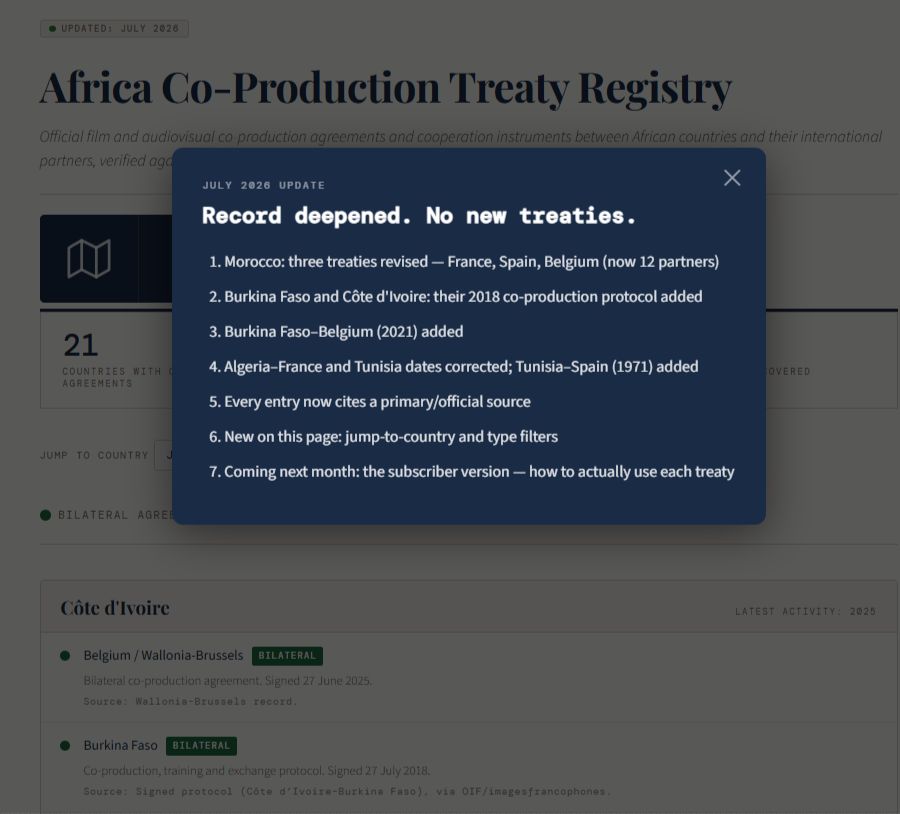
Morocco's record was the most incomplete. It now records a modernized treaty with France (first signed in 1977, modernized in 2024), treaties with Spain (1998), and Belgium's Wallonia-Brussels Federation (2000) — three long-standing details that were missing. Morocco moves from nine partners to an officially confirmed 12, which better fits its place as the continent's most connected co-production hub.
Elsewhere: Burkina Faso and Côte d'Ivoire gained the co-production protocol they signed in 2018, and Burkina Faso its 2021 agreement with Wallonia-Brussels.
Algeria's treaty with France, previously undated in the registry, is now fixed to its 2007 signing. Tunisia's date with Wallonia-Brussels was corrected to 1997, and its 1971 agreement with Spain added.
None of this changes the headline count. Every addition is a partner within a country already confirmed, so it holds at 21 of 54. But each entry is now truer to the record.
Every Source Traces to an Official Authority
I also held the whole registry to one sourcing rule: every agreement cites a primary or official source — the treaty text, the national film authority, the government gazette, written and/or verbal — not press coverage or secondary write-ups. For a tool professionals use to make real decisions, the citation should be the authority itself, not someone reporting on it. The handful of entries that leaned on secondary sources were re-verified and re-cited.
Faster to Navigate
The registry now opens with two controls, so you don't have to scroll to find what you need. A "jump to country" list takes you straight to any of the 21, and doubles as an at-a-glance view of which countries are confirmed.
Secondly, a type filter narrows the page to bilateral treaties, multilateral accords, or cooperation and MOU instruments on their own. Both bring onto the registry page what the map already offered, for anyone who lands on the registry first.
Next: The Subscriber Version
The registry has been free and open since I launched it, and it will remain so — at least the current version. Alongside it, I'm now actively developing a subscriber version for the professionals who will need to act on these agreements, not only look them up.
Where the free registry tells you a treaty exists, the subscriber version will tell you how to use it: for each active treaty, what it takes to qualify, including the contribution split, the minimum stake, the crew and cast requirements, whether it grants "national film" status, which authority approves it, and what each treaty unlocks in the countries involved.
I'm starting with South Africa's network of treaties and will preview what I can finalize by next month's update.
The Standing Note
The registry is the source of record; the map — access it here — is the fastest way to read it. Both update whenever an agreement is confirmed, ratified, or discovered.
Originally published to Akoroko Premium subscribers.