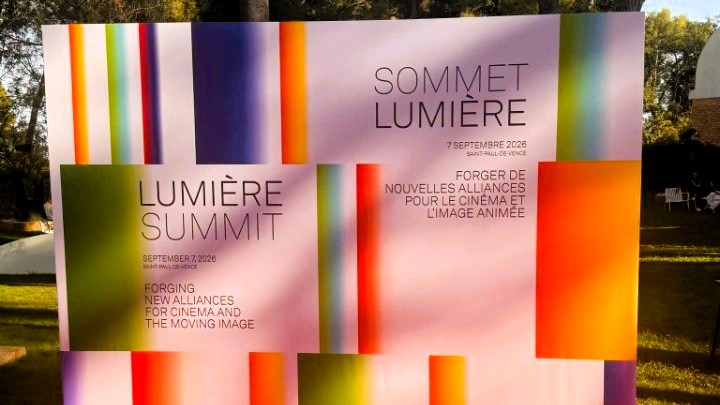
Nigeria and Morocco took formal roles in initiatives launched at the first Lumière Summit on 7 September 2026, while film professionals and public officials from several African countries participated in the one-day gathering in Saint-Paul-de-Vence, a town in southern France near Nice.
I wasn’t there in person for the event, but a few professional colleagues were.
Co-chaired by French President Emmanuel Macron and South Korean President Lee Jae-myung, the Summit brought more than 200 filmmakers, executives, public officials and cultural-sector leaders representing 60 countries, regions and international organizations to the Fondation Maeght, a modern-art museum in Saint-Paul-de-Vence. The meeting addressed film, television, animation, video games, artificial intelligence, distribution, exhibition, financing and audience development.
Macron announced Nigeria, South Korea and France as the initiating countries for a new global partnership on image education. He said the initiative, being developed with UNESCO and other partners, is intended to create educational programs that can be adapted across countries and age groups, covering how images are produced, manipulated and interpreted as well as how audiences encounter film, television and other audiovisual work. The "Lumière Declaration" separately calls for image literacy to become a basic form of literacy beginning in early schooling.
Morocco is one of the partner countries in IRIS, the International Resilience Initiative for Independent Screens, another initiative created at the Summit. The French presidency listed Morocco alongside South Korea, Portugal and Greece in the initiative, which is intended to support independent cinemas, distributors and networks responsible for circulating films. France says IRIS will combine financing, professional expertise and international cooperation, although detailed funding levels, application procedures and country eligibility haven't yet been published.
Morocco's state film authority, the Centre Cinématographique Marocain (CCM), separately confirmed that it joined the newly created Alliance Lumière as a founding member. The Alliance is a network of national public bodies responsible for film and audiovisual policy, intended to facilitate exchanges of expertise, joint initiatives and coordination on international issues. French President Macron said 54 agencies have joined the network and that members will meet annually at the Cannes Film Festival and at a separate congress hosted by a member state. A complete list of the 54 agencies hasn't yet been published.
The Summit's official program specifically identified Sub-Saharan Africa, alongside South Asia, in its discussion of audience access, stating that reaching audiences in these regions still depends on physical, broadcast and digital infrastructure capable of carrying films and other screen work.
African participants in the programmed sessions included Mo Abudu, founder and CEO of Nigerian media company EbonyLife, and Mehret Mandefro, co-founder of Realness Institute and managing director of the African Film and Media Arts Collective (AFMAC), representing Ethiopia. They joined a session exploring routes into professional leadership for younger generations.
Françoise Remarck, Côte d'Ivoire's Minister of Culture and Francophonie, joined Mauritanian filmmaker Abderrahmane Sissako for a session on creation and democracy. Côte d'Ivoire's Ministry of Culture independently confirmed that Remarck led the country's delegation to Saint-Paul-de-Vence. Moroccan filmmaker and producer Nabil Ayouch participated in a separate discussion on artistic freedom.
Magdalene Reddy, director of the Durban FilmMart Institute, the South African organization behind Durban FilmMart, joined festival leaders from Cannes, Berlin, Busan, Toronto and other international institutions in a session on the future role of film festivals.
The new IRIS initiative has already been connected to independent-cinema development in two additional African markets. In a statement distributed on 8 September 2026, the International Confederation of Arthouse Cinemas (CICAE) welcomed IRIS and cited participants in its recently completed Arthouse Cinema Training who are building new arthouse cinemas in Rwanda and Côte d'Ivoire. More on this initiative in a future Akoroko Premium dispatch.
Broader context: South Korea's role as Summit co-chair comes as it expands its institutional engagement with African countries. The first Korea–Africa Summit, held in South Korea on 4 June 2024, produced a joint declaration calling for expanded exchanges in culture and the arts alongside economic, technological and development cooperation. A follow-up Korea–Africa Foreign Ministers' Meeting in Seoul on 1 June 2026 reiterated those commitments and called for further exchanges in culture, arts, education, sports and tourism.
Screen sector activity is certainly part of that relationship. South Korea provided financing for Kenya's Konza Digital Media City, a planned media and creative-production hub at Konza Technopolis that includes film and broadcasting studios, post-production, animation, gaming and training facilities. Konza's development authority records a US$284.1 million financing agreement with South Korea, signed in June 2024.
South Korea's Ministry of Culture, Sports and Tourism is also funding “Cinelab: Igniting Digital Innovation and Policy Reform in the Film Industry in Cameroon,” under which Cameroon's government and UNESCO worked on revisions to the country's legal structure for film and audiovisual activity in August 2026.
South Korea’s recent engagement has also extended to filmmaker development. In May 2026, Seoul-based production company Flix Oven, working with production and representation company Continental Entertainment, launched an African–Korean filmmaker residency with Nigerian director C.J. Obasi as its first fellow. Obasi is scheduled to spend a month in Seoul developing a new feature connecting African and Korean cultures, with Morgan Freeman and Lori McCreary attached as executive producers through their U.S. company Revelations Entertainment.
Separately, France and South Korea used the Lumière Summit to launch the €1 billion Lumière Partnership for film, television and other moving-image businesses. France says it will commit €500 million through public investment bank Bpifrance between 2027 and 2031, with South Korea committing an equivalent amount. The partnership is open to additional states. No mechanism has yet been published to provide direct access to that financing for specifically African producers or companies.
The Summit concluded with the "Lumière Declaration," adopted by more than 120 signatories, and additional commitments covering artificial intelligence, image education, gender equality, environmental practices and working conditions.
It’s too early to tell which of the Summit’s commitments will develop into working programs, funding mechanisms, or lasting institutional relationships, particularly across African markets. Still, I’ll certainly be keeping an eye on what follows and assess accordingly.
For now, let's call it "cinematic statecraft." Governments using film policy, financing, institutions, education, exhibition, and international partnerships as instruments of geopolitical and cultural influence.
ORIGINALLY DISPATCHED TO AKOROKO PREMIUM SUBSCRIBERS.