A reminder for newer subscribers: this is updated monthly, or sooner when newly identified activity changes market conditions enough to matter. The goal over time is a first point of reference for how pricing, distribution, regulation, and ownership move across African markets, and how those shifts connect to the rest of the world. As months pass, the oldest entries drop off the visible timeline and map, while staying available in longer-range views and historical assessments.
Six new events have been added since the May update, bringing the total to 50 events across 54 African countries in the last 12+ months.
The biggest development since the May update is the men's football World Cup, which starts in June, and the question of how sub-Saharan Africa will watch it. It comes down to a handful of operators, one of them a company few outside Togo have heard of.
New World TV, a broadcaster based in Lomé, Togo, holds the primary rights to the 2026 World Cup across 43 sub-Saharan territories, South Africa included — a role it took from SuperSport for this cycle. It then sub-licenses those rights to pay-television and free-to-air broadcasters around the region.
Two of those sub-licensees confirmed their plans in the same window. Azam TV, a pay-television operator based in Tanzania, will air all 104 matches in eight markets — Tanzania, Kenya, Uganda, Malawi, Zambia, Botswana, Zimbabwe, and Rwanda — with separate Swahili and English feeds.
SuperSport, the sports network of the Canal+-owned MultiChoice group, will carry all 104 matches and, for the first time with a tournament this size, place them on DStv's cheapest Access package (from R99 a month, about US$6 at R16.20 to the dollar on June 2, 2026) instead of holding them for premium tiers.
For the market, the regional rights are currently held by a single holder in Lomé that parcels them out to pay-TV and free-to-air partners across the 43 territories.
On satellite internet, two developments. Uganda granted Starlink an operating license on May 15, settling a standoff that began on January 1, when the country forced the service to switch off all terminals within its borders. Starlink is now licensed in 28 African countries.
In South Africa — the largest market it still cannot enter — the communications regulator, ICASA, published draft rules on May 15 for licensing satellite services, covering the user terminals that Starlink, Amazon's LEO network, and others sell, as well as a registration system for foreign satellite operators serving South African customers. Public comment is open until June 29.
Meanwhile, the review of the country's Black economic empowerment ownership rules, covered last month, had a comment period that closed on May 20. The two tracks together will decide whether, and on what terms, foreign satellite operators can eventually work in South Africa.
In ownership, Canal+ took another step in absorbing the African pay-television group it bought last year. The French company won approval on May 12 to list its shares on the Johannesburg Stock Exchange, with trading to begin on June 3 under the code CNP. Canal+ keeps its main listing in London; the Johannesburg listing, agreed as a condition of South Africa's competition authorities clearing the MultiChoice takeover, makes it the first French company on the exchange. It lists with a market value of about £2.25 billion, roughly R51 billion (about US$3.1 billion).
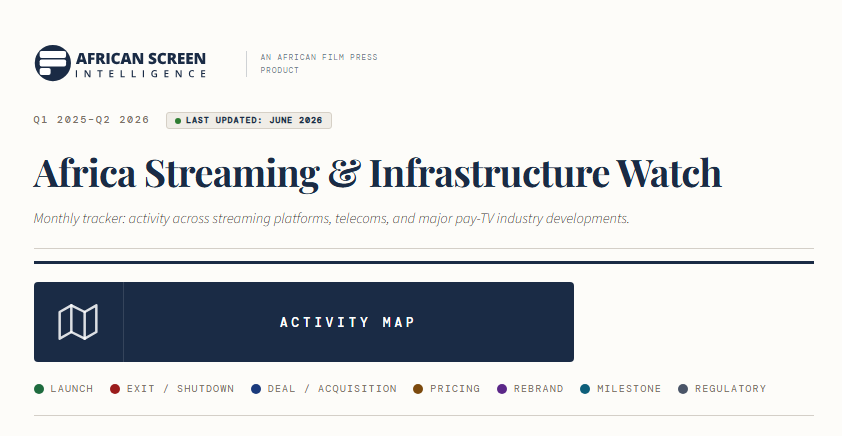
Visit and bookmark the African Film Press (AFP) Africa Streaming & Infrastructure Watch. The "Interactive Map" button is at the top of the page.
Note: Both the timeline and map are best viewed on larger screens, though each is also mobile-friendly.