Earlier this week, in a run of Instagram stories, I talked about how African films perform in the United States, and why I single out the U.S. at all. Two films prompted it. "Clarissa," the second feature from Arie and Chuko Esiri, premiered at Cannes in Directors' Fortnight in May, has Neon behind it, played Toronto this month, is on the New York Film Festival's main slate, and opens in U.S. cinemas on December 11. That's the kind of prestige run African films, especially sub-Saharan ones, rarely get in the U.S., and I'm watching to see what Neon does with it and how it performs.
The other is "Memory of Princess Mumbi," Damien Hauser's Kenyan genre hybrid, which Monument Releasing has just put into U.S. cinemas with so little marketing or publicity that most Stateside audiences don't know it exists. I think it has a U.S. audience. It's just not being given the chance to find one. But it's a familiar story...
The point I made in those Instagram stories was this (by the way, as subscribers, if you have an Instagram account and don't already follow me, do so, and send me a message alert. I will then add you to my "Close Friends" list, which is for subscribers only, giving you access to the occasional thoughts I share in that format): the U.S. is a major market, maybe "the" major market, and among major theatrical markets with substantial African and African diaspora populations — along with the UK, France, Germany, a few others — where one can expect significant enough audiences for African titles. The U.S. has been, and still is in 2026, the hardest for an African film to secure a theatrical release. Not on streaming, where most of these films will eventually be seen.
Theatrical is getting harder for every kind of film as cinema runs become scarcer and more expensive, financially and otherwise. For an African film, it takes something like "Clarissa": a festival pedigree, an influential distributor with a plan, and a cast or a story that a US audience already has a way into. Almost nothing on the list below went straight to U.S. cinemas without a festival premiere first.
I also said in those Instagram stories that Mauritanian filmmaker Abderrahmane Sissako's "Timbuktu" was, as far as I remembered, the highest-grossing, or among the highest-grossing, African film ever in U.S. cinemas, at a little over $1 million in U.S. theatrical receipts alone. That was from memory, from research I did about ten years ago. So I decided to look into this further for official records, especially given how many more African films are being made and released now than in 2015, when "Timbuktu" was released in the U.S.
This is the result of the entire rabbit-hole sprint above.
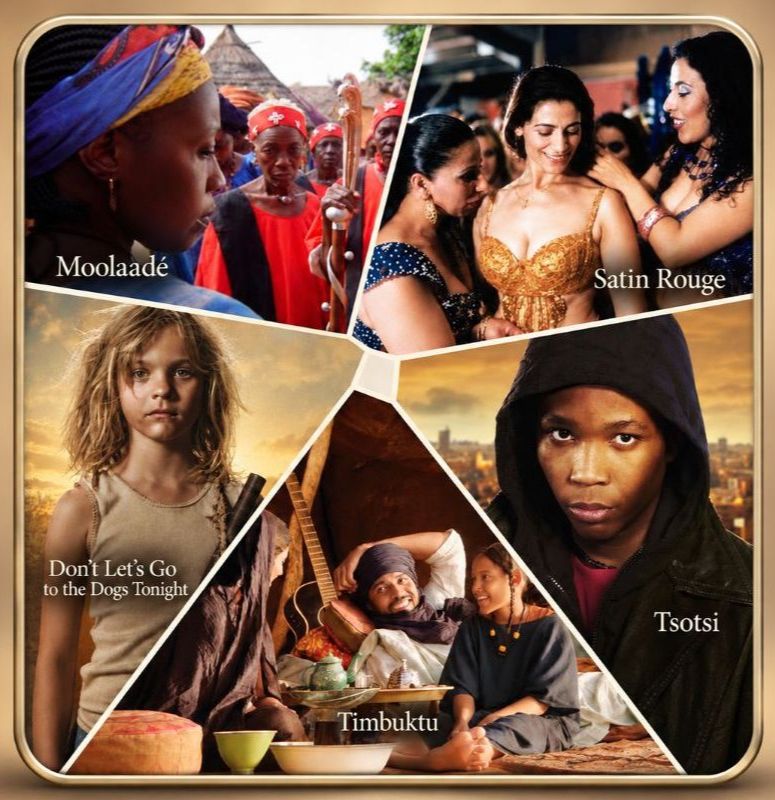
The short version: "Timbuktu," Abderrahmane Sissako's Mauritanian-French production set in Mali, is second. "Tsotsi," Gavin Hood's 2005 South African film, which won the Academy Award for Best Foreign Language Film and was released in the U.S. by Miramax, grossed $2.9 million, close to three times "Timbuktu." Nothing released since 2015 has come near either.
The best U.S. theatrical result for an African film in the past decade is "Don't Let's Go to the Dogs Tonight," Embeth Davidtz's South African adaptation of Alexandra Fuller's memoir, which grossed $639,310 for Sony Pictures Classics in 2025; it's set in 1980 Zimbabwe — Rhodesia at the time — and is told from inside a white settler household.
Below it, the numbers fall fast. Only 15 films in the whole 53-film record have passed $100,000 in U.S. cinemas.
How I Did This The figures are "domestic" grosses as Box Office Mojo and The Numbers report them, meaning the United States and Canada together, in nominal dollars, across all years on record up to this week. Those two trackers source every figure; where they disagree, both numbers appear in the full list.
A note on Canada: neither tracker separates it. Box Office Mojo defines "Domestic" as North America — the US, Canada and Puerto Rico — because that's how these films are sold, with U.S. and Canadian rights going in one deal and one reported figure coming back. However, buying the territory isn't the same as playing it; a distributor holding North American rights may never book the film into a Canadian cinema, and the trackers wouldn't tell us either way. What we can say is that the U.S. side almost certainly accounts for most of any figure below. It has roughly eight times Canada's population, almost as many times the number of cinema screens, and a far larger African and African-diaspora audience. So read every number here as U.S. and Canada combined, with the U.S. carrying most of the weight. Sorry, Canadians!
I counted a film as "African" when four things are true: an African director (including diaspora-born directors of African parentage, like Mati Diop or Akinola Davies Jr.), an African story, an African cast, and an African setting.
A film is excluded if it had the might of the Hollywood machine behind it (financing through distribution), which removes "District 9" (2009), "Chappie" (2015), "Sarafina!" (1992), and "The Gods Must Be Crazy II" (1989).
A U.S. distributor buying a finished film is, of course, fine; "Tsotsi" (2005) at Miramax and "Life, Above All" (2010) at Sony Pictures Classics are pickups, not original studio productions.
Another key note: "The Gods Must Be Crazy" (1980), the first in the franchise, at $30 million, by far the biggest U.S. gross of any African-made film (South Africa), is flagged in a separate tier. It was made under apartheid's state film subsidy, sold abroad as Botswanan during the cultural boycott, picketed by anti-apartheid groups in the U.S. in 1984, and criticized by African writers and by anthropologists for its portrayal of the San, the Indigenous peoples of southern Africa represented in the film.
Incidental and useful to my research process is that it also identified the U.S. distributors that have acquired and released the best-performing African films across the twenty-five years the list of 53 titles covers: Kino Lorber and ArtMattan lead with the most titles each, followed by Film Movement and, in the earlier years, New Yorker Films, which shut down in 2009, was briefly revived, and has been inactive for years.
An aside: I remember seeing the New Yorker Films label on VHS covers when I first ventured into African cinema 25 years ago. The company put out "Xala," "Mandabi," "Camp de Thiaroye," "Yaaba," "Guelwaar," "Faat Kiné," and others for American audiences. At one point, if you were watching African films in the U.S. on physical home video formats, you were watching founder Dan Talbot's catalog. Talbot passed away in 2017.
I should draw your attention to New York-based ArtMattan, second with seven titles, as the only distributor near the top that's run by people of African descent: Diarah N'Daw-Spech, born in France to a Malian father, and Reinaldo Barroso-Spech, born in Cuba of Haitian and Jamaican descent. They started the African Diaspora International Film Festival in New York in 1993 and set up ArtMattan Films as a distribution arm the following year; the catalogue now includes more than 100 titles from Africa, the Caribbean and Europe, and they have since added a VOD platform, ArtMattanTV. Thirty-odd years of getting these films into U.S. cinemas, one title at a time.
It's important to note that this list is not final. I simply can't be fully certain that every qualified film has been captured here. No one can be. Even with new technologies that make the research process far less of a burden and far more efficient, releases can go underreported or unreported, especially from the 1980s and 1990s, and especially for self-distributed films.
My informed guess is that the list captures most of the record. And what started as an itch I needed to scratch will become a permanent fixture, at least internally. I'll update it if new evidence requires it. I may create a similar list for other major markets where African films struggle to get into cinemas. But note that the African Film Press (AFP) Distribution and Box Office Registries are built to carry on this kind of work, starting in the post-pandemic years, tracking title theatrical, streaming, and broadcast life around the world.
This side project may end up feeding those registries, or being fed by them.
One last thing before the actual list...
Stats and Charts Some noteworthy statistics with accompanying visualizations:
— Scale. Every film in the ranking, added together, has taken $7,204,021 in US and Canadian cinemas across all years on record. "The Gods Must Be Crazy" took four times that on its own in 1984, and "District 9" took sixteen times it in 2009. Both are excluded from the ranking for the reasons stated above, which is the point.
— Where the films land. Two films have crossed $1 million. Thirteen are between $100,000 and $1 million. The remaining thirty-eight are below $100,000, and sixteen of those took in less than $10,000. The median gross is $28,575, which is closer to a weekend in one theater than to a release.
— Distributors. Kino Lorber has released the most of these films, with nine, followed by ArtMattan with seven, then New Yorker Films, and Film Movement with five each. Twenty distributors appear once and never again. Four companies account for close to half the list.
— Directors. Only seven directors have more than one film here, and none has more than three. Abderrahmane Sissako and Mahamat-Saleh Haroun both have three, but Sissako's three total $1,195,832 and Haroun's three total $40,718 — a thirty-fold gap between two filmmakers of the same generation with the same number of US releases. Meanwhile, Rungano Nyoni and Kaouther Ben Hania bring some gender balance to the short list.
— Countries. South Africa leads with twelve films, Senegal follows with nine, then Tunisia and Egypt at six each. Co-productions count once for each African partner, so "Moolaadé" alone appears in five countries — Senegal, Burkina Faso, Morocco, Tunisia and Cameroon — meaning the bars on this chart add up to more than the 53-title count.
And now, without further ado...
The Top 20, by U.S. and Canadian Theatrical Gross These are the twenty films on record with a U.S. box office gross of at least, or hovering around, $50,000. I cut it there because the drop after it is steep: the twenty-first, "Casablanca Beats," took $32,790, and nothing below that point has passed $33,000. Also, as the chart above shows, half of the remaining titles earned less than $10,000. And this email is already very long.
I will maintain the full list internally and share if any major shifts occur.
"Tsotsi" (2005) — Gavin Hood, South Africa — $2,912,606 — Miramax, 2006 "Timbuktu" (2014) — Abderrahmane Sissako, Mauritania — $1,076,075 — Cohen Media Group, 2015 "Don't Let's Go to the Dogs Tonight" (2024) — Embeth Davidtz, South Africa — $639,310 — Sony Pictures Classics, 2025. "Satin Rouge" (2002) — Raja Amari, Tunisia — $231,879 — Zeitgeist Films, 2002. Palestinian lead actress Hiam Abbass, otherwise Tunisian story and Tunisian/French-Tunisian cast. "Moolaadé" (2004) — Ousmane Sembène, Senegal — $215,646 — New Yorker Films, 2004 "Neptune Frost" (2021) — Anisia Uzeyman, Rwanda, with Saul Williams, U.S. — $193,875 — Kino Lorber, 2022 "On Becoming a Guinea Fowl" (2024) — Rungano Nyoni, Zambia — $166,851 — A24, 2025. A24, a New York independent, co-financed. "My Father's Shadow" (2025) — Akinola Davies Jr., Nigeria — $142,625 — MUBI, 2026 "Four Daughters" (2023) — Kaouther Ben Hania, Tunisia — $138,180 — Kino Lorber, 2023 "Rafiki" (2018) — Wanuri Kahiu, Kenya — $137,968 — Film Movement, 2019 "Life, Above All" (2010) — Oliver Schmitz, South Africa — $134,461 — Sony Pictures Classics, 2011 "Gaia" (2021) — Jaco Bouwer, South Africa — $126,126 — Neon, 2021. The Numbers' figure; Box Office Mojo shows $17,530. "The Square" (2013) — Jehane Noujaim, Egypt — $124,244 — Noujaim Films, 2013 "Bamako" (2006) — Abderrahmane Sissako, Mali — $112,351 — New Yorker Films, 2007 "Dahomey" (2024) — Mati Diop, Benin and Senegal — $100,959 — MUBI, 2024 "Viva Riva!" (2010) — Djo Tunda Wa Munga, DR Congo — $61,759 — Music Box Films, 2011 "Half of a Yellow Sun" (2013) — Biyi Bandele, Nigeria — $54,529 — Monterey Media, 2014. Diaspora and American leads. "I Am Not a Witch" (2017) — Rungano Nyoni, Zambia — $50,868 — Film Movement, 2018 "Difret" (2014) — Zeresenay Berhane Mehari, Ethiopia — $49,667 — Truth Aid, 2015 "Banel & Adama" (2023) — Ramata-Toulaye Sy, Senegal — $49,503 — Kino Lorber, 2024
Again, the internal full audit is currently at 53 films with tracker figures, plus the flagged tier: films with documented US releases and no reported gross, and the excluded titles with their grosses and reasons. I will report back if any major moves occur.