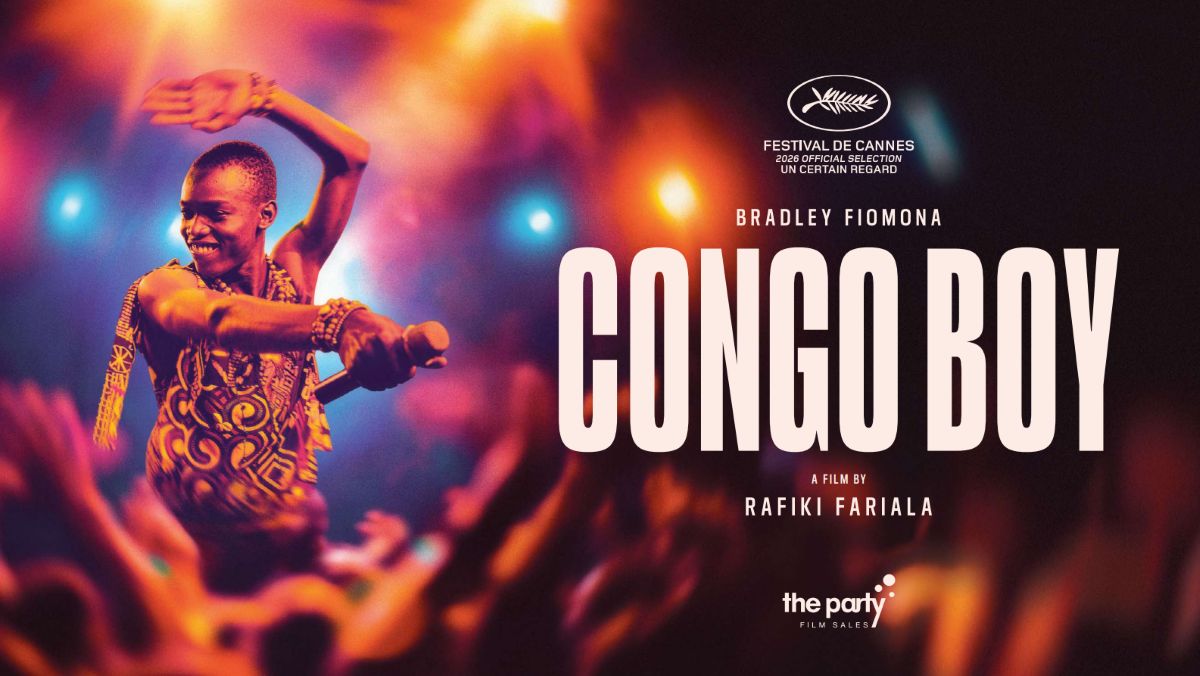
Bradley Fiomona Dembeasset won Best Actor at Cannes' Un Certain Regard on Friday, 22 May 2026, for his lead in Congo Boy, directed by Rafiki Fariala. He closed his acceptance speech in song, finishing with: "I am a young Congolese! I am a refugee! I am a star!"
Of three African films selected for Un Certain Regard 2026 — alongside Laïla Marrakchi's La Más Dulce (Morocco) and Marie-Clémentine Dusabejambo's Ben'imana (Rwanda) — it was the only one to win a prize.
The Un Certain Regard jury was chaired by Leïla Bekhti, with Senegalese producer Angèle Diabang among its members.
His win is the fourth African acting prize given at Un Certain Regard in five editions since 2022. The seven calendar years before that produced no African acting winners in the section.
Between 2015 and 2021, with no regular Cannes edition in 2020, Un Certain Regard handed out three individual acting prizes total: Jasmine Trinca (Italian) for Fortunata in 2017, Victor Polster (Belgian) for Girl in 2018, and Chiara Mastroianni (French) for Chambre 212 in 2019.
Note that the 2015, 2016, and 2021 award lists don't name an individual acting prize.
Since 2022, four African performances have been recognized:
- Tunisian-French actor Adam Bessa took the 2022 Best Performance Prize ex-aequo with Vicky Krieps for Lotfy Nathan's Harka.
- Guinean auto mechanic Abou Sangaré won Best Actor in 2024 for Boris Lojkine's L'Histoire de Souleymane.
- Cape Verde-born actress Cleo Diára won Best Actress in 2025 for Pedro Pinho's O Riso e a Faca (I Only Rest in the Storm), set in Guinea-Bissau.
- Fiomona Dembeasset took Best Actor on Friday.
Note that 2023 gave no individual acting prize.
The casting principle across wins seems to be to cast the lead from the same world as the film depicts:
- Bessa is Tunisian-French, playing a Tunisian street vendor, directed by an Egyptian-born British filmmaker.
- Sangaré is an undocumented Guinean migrant playing an undocumented Guinean migrant — found by Lojkine's team at an open casting call in Amiens, where he had been seeking legal status without success. Still is, last I checked a month ago.
- Diára — a slight difference — plays a Bissau-Guinean woman entangled with a white Portuguese engineer in a film about post-colonial extraction, directed by a Portuguese filmmaker. Diára is based in Portugal.
- Fiomona Dembeasset plays a Bangui teenager surviving civil war, and from the Debussy stage declared himself "a young Congolese" and "a refugee." His director, Fariala, was born in 1997 in Uvira, Kivu (DRC), and arrived in CAR as a young child with his Congolese parents, who had sought refuge there due to the war.
Akoroko's historical Cannes data also shows that African films have most often reached the festival via the Un Certain Regard section, followed by Directors' Fortnight (Clarissa and two shorts this year), and International Critics' Week (nothing this year).
Congo Boy follows 17-year-old Robert, a Congolese refugee living in Bangui, Central African Republic, who is left to care for his four younger siblings after both his parents are imprisoned. He juggles daily life, odd jobs, school exams, and concert stages, holding onto his dream of a music career. It's Fariala's first narrative feature, following his 2022 documentary Nous, étudiants!
The film is a Central African Republic–France–DRC–Italy co-production from Makongo Films, Unité, Kiripifilms, and Karta Film.