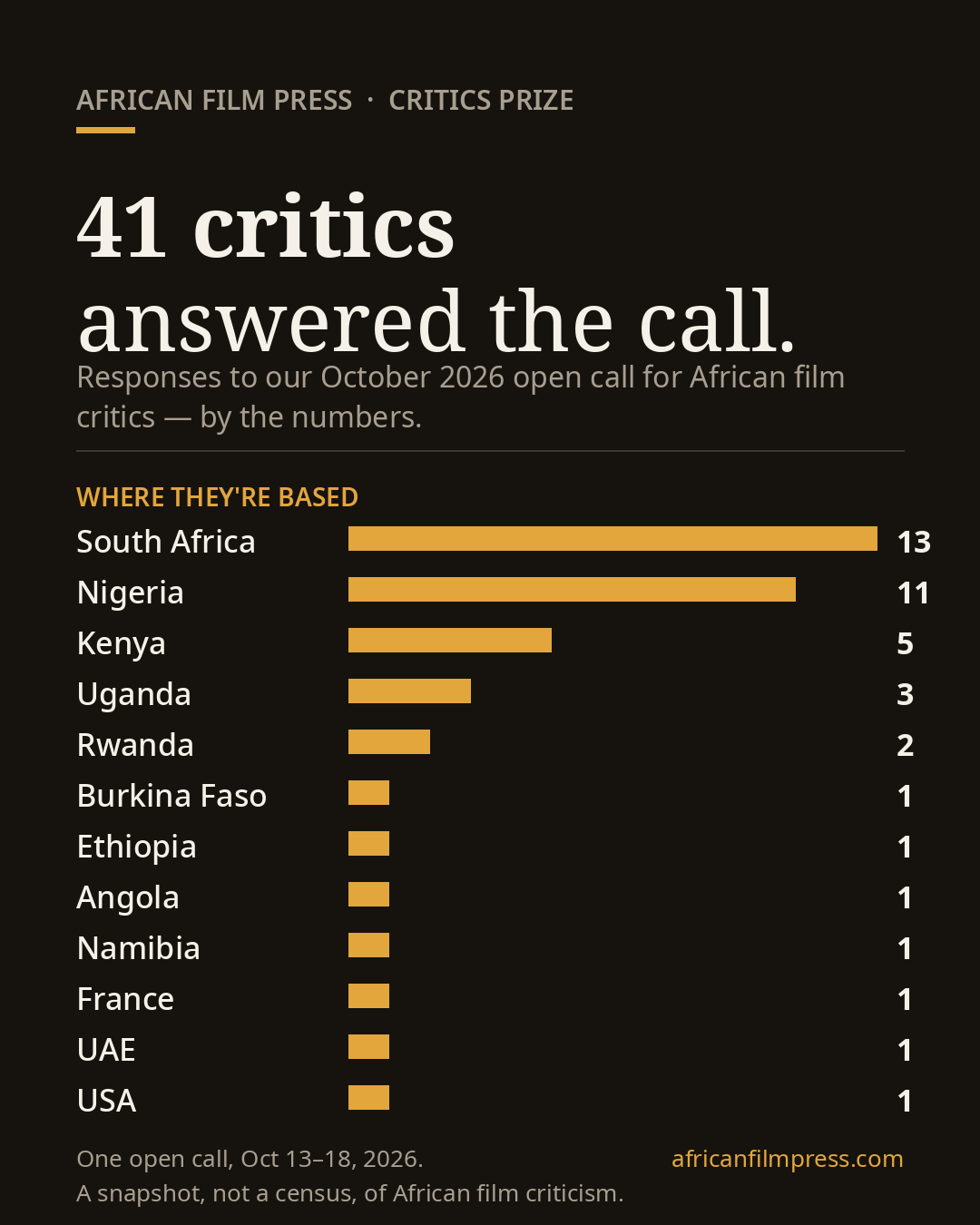
Earlier this month, African Film Press (AFP), the alliance of Akoroko, Sinema Focus, and What Kept Me Up, invited African film critics to join our growing roster of independent jurors for the AFP Critics Prize. The call generated 41 expressions of interest from 12 countries, giving us an early picture of who we're reaching, where interest is concentrated, and where our recruitment needs to expand.
The response has also got us thinking about what this growing pool of critics could become beyond the prize itself. We're beginning to build relationships with people working in different parts of Africa's film criticism community, and there may be opportunities to bring some of them together around other activities we're considering.
The Call and the Response
The AFP Critics Prize works with film festivals to recognize short films selected by independent three-person juries. Jurors watch approximately five or six films remotely, deliberate together, and choose a winner. Their names and collective citation appear on the official prize certificate.
Our next two juries are planned for the Kilifi Creek Festival in Kenya (23–31 October 2026) and S16 Film Festival in Lagos, Nigeria (early December 2026).
The call welcomed published film criticism across websites, newspapers, newsletters, blogs, YouTube, podcasts, and other platforms, in any language, provided applicants could participate in English-language deliberations. Women critics were especially encouraged to apply.
Of the 41 expressions of interest, 38 came from people based in Africa, with three in the diaspora: France, the United States, and the United Arab Emirates.
The African responses came from nine countries:
- South Africa: 13
- Nigeria: 11
- Kenya: 5
- Uganda: 3
- Rwanda: 2
- Ethiopia, Burkina Faso, Angola, and Namibia: 1 each
Geographically, the largest concentrations were Lagos (9), Johannesburg (7), Cape Town (5), Nairobi (5), and Kampala (3). South Africa, Nigeria, and Kenya together accounted for 29 of the 38 Africa-based responses, approximately 76%.
The 41 expressions of interest included 27 people working primarily in written criticism, six focused on video, three combining writing and video, three filmmakers who also participate in juries, and two whose initial responses sought clarification about eligibility.
The gender distribution was nearly even: 20 women and 21 men, with women accounting for 49% of all respondents.
What We're Learning
These figures describe one open call and the people it reached. They provide useful information for AFP's next recruitment rounds, although they cannot establish the overall composition of African film criticism.
Language and geographic reach. The announcement was published in English, and most responses came from English-speaking African countries. Burkina Faso supplied a French-language critic, and Angola supplied a respondent from a Portuguese-speaking country. There were no responses from North Africa. Future recruitment will need to reach critics working in French, Portuguese, and Arabic, including those outside AFP's existing professional networks.
Concentration in major media cities. Lagos, Johannesburg, Cape Town, Nairobi, and Kampala accounted for most responses. These cities have established publishing and audiovisual media communities, although AFP's own audience and the circulation of the announcement likely influenced the results. The distribution gives us a practical starting point for extending recruitment to other cities and countries.
Different forms of criticism. Nine respondents identified video as their principal format or combined it with writing. AFP's jury recruitment will continue to accommodate critics publishing across written, audiovisual, and digital platforms.
Women's participation. The near-even gender distribution is encouraging, particularly given the call's explicit invitation to women critics. It provides a useful baseline for future recruitment.
Building Beyond the Prize
The immediate task is selecting jurors for Kilifi Creek and S16, subject to eligibility and availability. But we're also interested in the longer-term possibilities of maintaining relationships with this growing group.
Many respondents appear to be relatively young or early in their critical careers, and their work represents different approaches to writing, discussing, and evaluating films. As the roster grows, we'd like to learn more about their interests, experience, and the kinds of professional opportunities they would find useful.
This first exercise has already prompted further thinking about how AFP might engage these critics beyond individual jury assignments. We're exploring ideas for events and initiatives across Africa and internationally that could involve members of the group, including activities separate from the AFP Critics Prize. We'll share details once those plans are developed and finalized.
We also plan to issue future calls in French, Portuguese, and Arabic as the AFP Critics Prize expands its engagement with festivals and film markets in Francophone, Lusophone, and Arabophone Africa. Conversations are underway with festivals in Angola and Senegal, with further details to follow once partnerships are confirmed.