Canal+'s FY2025 Results and 2026 Africa Outlook
The numbers Canal+ released on March 11 tell two stories at once. In French-speaking Africa, where the company has operated since the 1990s, 2025 was one of the strongest subscriber years in 15. The base reached 9.7 million, up from 8.7 million at end-2024, driven in part by AFCON (sports) rights, which drew peak audiences of 5 million viewers for a single match in Morocco. Canal+ Africa CEO David Mignot, who took the role in 2012 when the Francophone subscriber base stood at around 400,000, described the growth trajectory: the base has multiplied by more than 20 in his tenure.
Then there is MultiChoice. The South African-headquartered pay-TV group that Canal+ completed acquiring in late 2025, after years of incremental stake-building, lost 500,000 subscribers in 2025. Revenue fell 6 percent. Adjusted earnings before interest and tax dropped 14 percent. Free cash flow was negative. Canal+ absorbed it into its results for only three months and eleven days of the financial year, and still felt the weight.
Combined, the two businesses now cover 42.3 million subscribers in more than 70 countries, making Canal+ the dominant pay-TV operator across the African continent by subscriber count. The question the results were always going to be asked to answer is whether the acquisition is a platform for continental growth or an expensive inheritance of someone else’s problems. The honest answer, based on what management disclosed, is both.
The Diagnosis Canal+ chief Maxime Saada and Mignot delivered a candid presentation to analysts. MultiChoice’s decline over the past three years was not, in their framing, the product of a single failure. Currency devaluation — Nigeria is named explicitly — power cuts, price increases applied without supporting investment in the commercial engine, and the heavily subsidised collapse of Showmax all compounded each other. The company tried to stop the slide by raising prices and cutting subsidies for subscriber acquisition. Those moves made the original problems worse. In other words, currencies collapsed, power grids were unstable, and a costly streaming bet failed. Then, already wounded, the company raised prices, pulled back from winning new customers, and lost even more of both money and customers.
Showmax, the streaming service MultiChoice relaunched in 2024 with Comcast’s Peacock technology and roughly $309 million in combined equity investment, is now officially described by Canal+ as an “expensive failure.” The service generated only R753 million (about $46 million) in revenue in its final full year — down from approximately R1 billion the year prior, even as paid subscriber numbers rose. More subscribers, less money.
Subsequently, Canal+ walked away from the Showmax contract in early 2026. The losses were real, the market was not developing fast enough, and Canal+ had a different clock. The closure leaves Netflix as the only major commissioning streamer operating at scale in Africa that is not Canal+ itself.
What the March 11 webcast presentation made concrete, in a way the written earnings statements did not, was the structural gap between what MultiChoice is today and what a functioning mass-market pay-TV business in Africa looks like. Two numbers in particular:
Entry cost. The price of a decoder, satellite dish, and one month's subscription can fall to around €13 in Canal+ markets. In MultiChoice markets, the equivalent figure is typically three times higher.
Distribution. For every shop or kiosk selling decoder equipment relative to households with electricity, Canal+ markets have three and a half times as many as MultiChoice's.
Price and access: both broken in the same direction.
The commercial architecture compounds the problem. MultiChoice currently offers 17 price points and up to 5 decoder models. On the branding side, it runs DStv for satellite, GoTV for terrestrial, and, until recently, maintained both Showmax and DStv Streaming for OTT, which means separate marketing spend, separate subscriber acquisition paths, and diluted brand equity across all of them.
Canal+ uses a single master brand across all of its markets and delivery methods. MultiChoice does not.
What Canal+ Is Actually Doing About It
Their 2026 plan has a specific name — the "Boost Plan" — and a specific budget: €100 million, self-funded from cost savings already secured, not drawn from new capital. Mignot described it as money spent on acquiring subscribers. Canal+ is simultaneously running a voluntary severance programme in back-office staff and restructuring Irdeto, MultiChoice's technology and cybersecurity subsidiary.
The four pillars of the turnaround, as presented:
Content. More of it, more local. No details provided on how and when.
Simplification. Seventeen price points become fewer. DStv, GoTV, DStv Streaming get snipped. SuperSport is strong enough to keep its name. Everything else is under review.
Getting people in the door. Subsidised equipment to close the entry-cost gap, expanded retail presence, and more than 1,000 new salespeople hired across MultiChoice markets.
Operational discipline. Canal+ runs what it calls the "Mastermind framework": 15 functions, 270 identified best practices, tracked across 30 business units and countries. Seems standard. The example Mignot gave: in some MultiChoice markets, top channels were not available for replay on the app. They are being fixed.
A note on content: Canal+ says it already produces 10,000 hours of local African content each year across more than 100 in-house channels, in over 50 languages. The production infrastructure is supported by equity stakes in ROK Studios (Nigeria), Plan A (Ivory Coast), Zacu Entertainment (Rwanda), and Marodi TV (Senegal). The South African production base — the Showmax Originals catalogue — migrates to linear DStv channels: Africa Magic, M-Net, kykNET, Mzansi Magic.
Since completing the MultiChoice acquisition, Canal+ has already begun pushing content across the combined system: English-language options from MultiChoice have been added for current Canal+ Africa Francophone subscribers, and some SuperSport and National Geographic content has been added to Canal+ markets. To be clear, none of this is newly commissioned. It's existing content, redistributed across a larger footprint. These are early-stage moves, but Mignot's point is that the combined scale makes them immediately possible. MultiChoice alone could not negotiate the same breadth of content deals that the merged group can.
MultiChoice subscriber counts are still expected to fall in 2026. Revenue will still fall, but more slowly. Management is not projecting a turnaround in 12 months, or even 36 months. They spoke the language of stabilization, describing 2026 as a reset, a kind of tabula rasa.
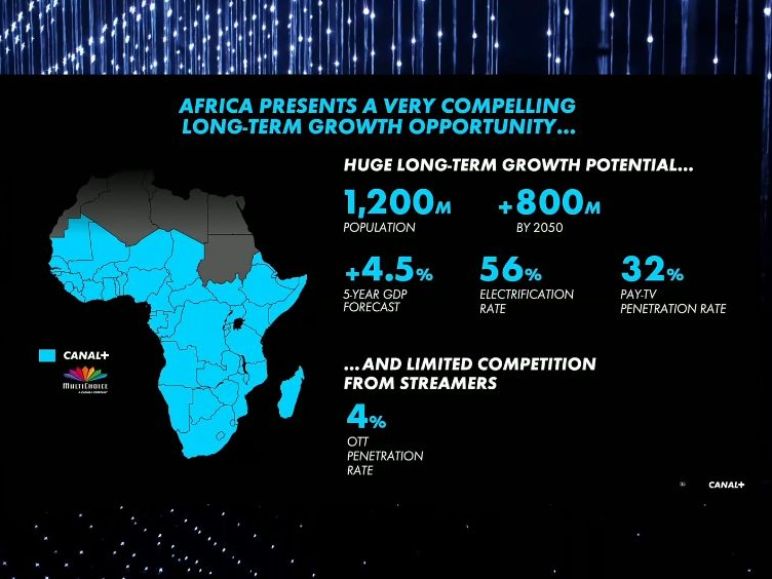
Mignot made the infrastructure gap explicit: OTT penetration in Canal+ and MultiChoice markets (sub-Saharan Africa) is currently around 5 percent. That means 95 percent of sub-Saharan African households are not connected to fixed broadband. Consequently, satellite will remain the primary content delivery method across much of the continent for "a long time," he said.
To piggyback my March 7 dispatch, "After Billions Spent: What It Takes to Succeed in African Streaming" report, what Mignot is ultimately saying here is that, for any new streaming platform with pan-African ambitions, the realistic picture is: you are building for mobile, not TV screens; you need telco partnerships to bundle data costs into the subscription price; your potential paying audience is concentrated in a handful of major African cities; and you are asking people to spend money on entertainment in markets where internet access itself already consumes a disproportionate share of income.
The Longer Game Canal+ is laying the groundwork for a decade-long transformation. That was made clear during Mignot's 20-minute Africa segment during the company's March 11 presentation.
Saada has stated a combined (Canal+ and MultiChoice) global subscriber target of 50-100 million by 2030, with Africa as a key part of its strategy. Getting there from around 43 million requires net growth. Net growth in Africa requires the MultiChoice business to stop declining and start adding.
Beyond the 2026 turnaround work, three moves suggest where the combined group might be headed.
First, a unified OTT platform. The Canal+ App — previously called myCANAL, already live across 30-plus countries and all Francophone African markets — is the intended single streaming product for Anglophone Africa once the Showmax infrastructure winds down. Mignot described the long-term aim as unifying platforms in line with what Canal+ has done in France. That rollout also involves telco partnerships and smart TV integration with manufacturers, including Samsung and LG. No telco partners are yet named. No timeline is committed beyond “long-term.”
Second, AI tools tied directly to the subscriber experience. Two deals announced with the March 11 FY2025 results are noteworthy here. From June 2026, OpenAI’s technology will power content search and discovery in the Canal+ App, providing a natural-language interface that lets subscribers describe what they want to watch in their own words, based on preferences, mood, or curiosity, rather than navigating a menu. Separately, a multi-year partnership with Google Cloud will use Veo 3, Google’s generative video AI, within Canal+’s production workflows: pre-visualising scenes before shooting and recreating historical moments from archival photographs. Both tools will be deployed across European and African Canal+ App markets.
Third, the JSE (Johannesburg Stock Exchange) secondary listing, confirmed for the first half of 2026. Canal+ currently trades on the London Stock Exchange. A Johannesburg listing is partly symbolic of a genuine long-term commitment to the continent, than a financial extraction play. It's also practical, giving South African institutional investors direct access and reducing some of the friction that comes with managing a South African business from a London primary listing.
Two key questions that remain open after today:
The most important for many: What does the post-Showmax commissioning weight and original content slate look like for Anglophone Africa?
How will the Canal+ app roll out across Anglophone Africa — which countries, in what order, on what infrastructure timeline? Canal+ has been in Africa long enough and has given its infrastructure advantage enough thought to understand that the continent does not reward short-cycle understanding. The March 11, 2026, presentation gives a much clearer picture of the company's near-term Africa playbook than of any long-range creative or market-shaping vision.
The concrete items are cost discipline, sales-force expansion, equipment subsidies, simpler offers, branding cleanup, and overall trimming of the fat, so to speak. Less evidence on future commissioning, country-by-country content strategy, or how Canal+ plans to turn “best content on the continent” (as Mignot said) into a measurable operating plan beyond sports, aggregation, cutting costs, and growing revenue.