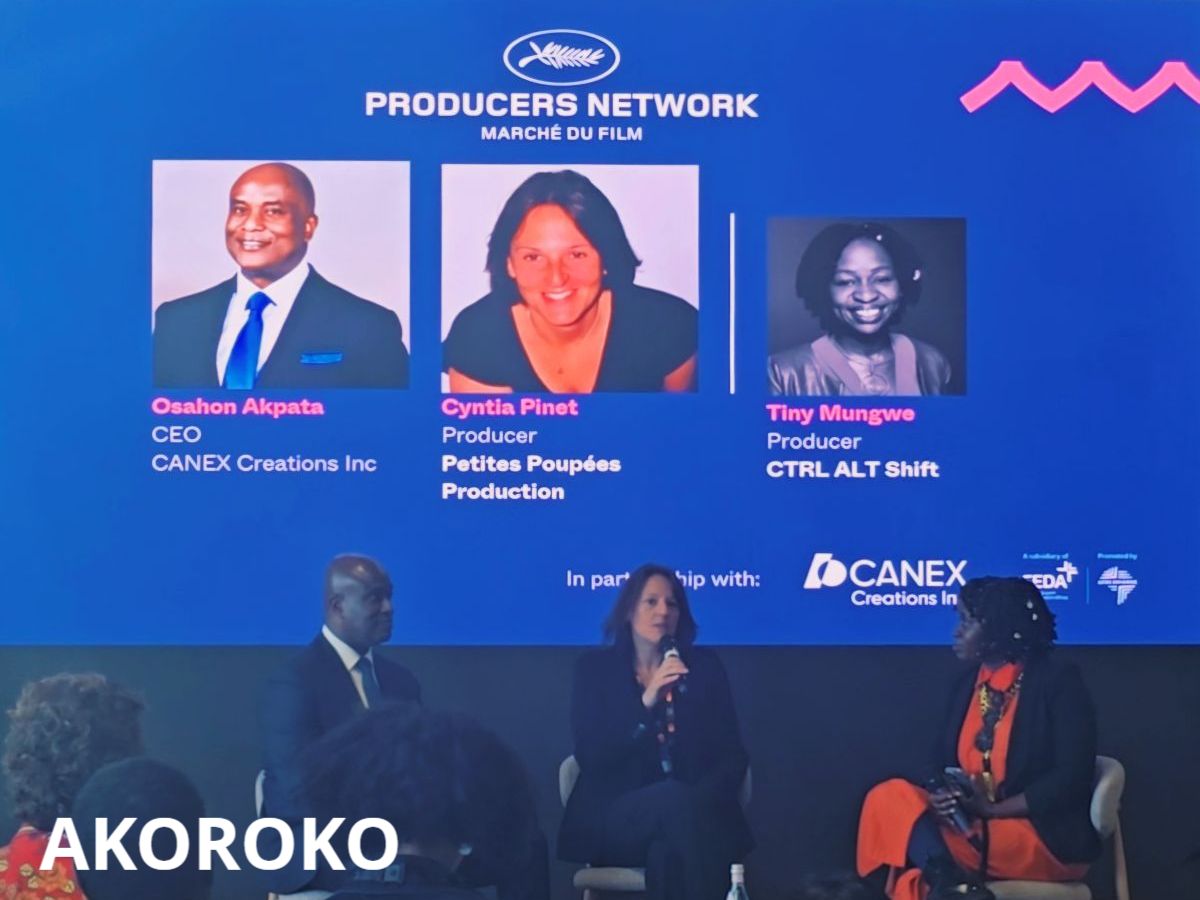
At the Cannes Marché du Film on 14 May 2026, CANEX Creations Inc. used two conference sessions to set out the terms on which it invests in African intellectual property (IP), particularly film.
CANEX Creations Inc. (CCInc), a wholly owned subsidiary of Afreximbank's Fund for Export Development in Africa (FEDA), is a separate entity from the Creative Africa Nexus (CANEX) programme that shares its name. The latter is Afreximbank's wider creative economy initiative, with a $2 billion facility across financing, capacity building, market access, and policy work.
CCInc's own remit is narrower and more specific. For producers considering it as a financing partner, the terms are these, in brief: tickets between $500,000 and $5 million, taken as a strategic minority equity position; an African subject; institutional financing partly assembled; a distributor or a credible sales agent attached; and a workable repayment path.
The first Marché conference session was the impACT panel, "Producing the Future: Innovative Financing Models for African Cinema," with Susan Mbogo, executive director of DocuBox; Osahon Akpata, chief executive officer of CANEX Creations Inc.; Andria Wilson Mirza, director of international programs at Women in Film; Cecilia "CC" W'emedi, senior project manager at Women in Film; and Samuel Tebandeke, producer at Kiasi Productions, who moderated.
The session that followed later in the day, "Financing African Film for Impact: Muganga Case Study," was moderated by Tiny Mungwe, producer at CTRL ALT Shift, and included CCInc's Akpata and Cynthia Pinet, producer at Petites Poupées Production.
At the impACT panel, Akpata traced CCInc's origin. Afreximbank's Creative Africa Nexus programme launched around six years ago, opened a debt financing facility about four years ago, and registered CCInc roughly two years ago. The bank had determined that the creative industries also needed equity capital, since most of the businesses across the sector are small and venture-stage.
Akpata separated the model from grant financing: CCInc is an equity investor that has to recover its capital, with a strategic minority stake usually ranging from 20% to 40% of a project's budget.
The ticket size band has a rationale on both ends. Akpata said CCInc would not finance a $100 million project, because even its maximum $5 million ticket would be too small to give the company any real say in how the project is run. It would also not finance a $300,000 project, because the company does not fund 100% of any film, and the legal and due diligence costs a development finance institution (DFI) incurs on a single transaction can run into tens of thousands of dollars. The project needs to be large enough to justify the overhead.
Smaller-budget productions, Akpata said, are often better served by local financiers. He cited one Nigerian company that has financed 39 films — likely MBO Capital, the Lagos-based investment firm that co-financed the Cannes-selected "Clarissa" — that many local filmmakers don't know exists.
The criteria beyond the dollar figures follow the same line of thinking. Akpata said CCInc looks for filmmakers with commercially successful work behind them. The company does not require capacity building as a precondition of financing, but it does require development impact — local capacity transfer that comes with the production. He cited "Dust to Dreams," a short film directed by Idris Elba and produced by Elba and Mo Abudu, where the local Nigerian crew worked alongside Elba and learned from his experience on larger productions.
For projects that don't fit the equity vehicle, Akpata pointed to the wider Afreximbank Group. The bank itself has a film financing facility that starts at around $2 million on a debt basis. Debt requires something to hold against — a pre-sale to a streamer, a minimum guarantee from a distributor, or another secured commitment. CCInc itself can do some venture debt with collateral, but its core instrument is equity.
In essence, equity is a stake: CCInc owns a piece of the project and shares in its earnings or losses. Debt is borrowed money, typically a loan: the lender expects repayment and needs to see, in advance, where that money will come from.
On risk, Akpata said the main question is whether the package provides sufficient cover to ensure the money returns. That cover can come from a distributor on the project who has previously released films of the relevant type, a minimum guarantee in one or more territories, pre-sales, sales estimates from someone with the experience to know how a particular type of film actually sells, and conservative projections rather than the optimistic ones filmmakers tend to favor.
"Muganga" was offered as a working example during the later case study session. Cynthia Pinet of Petites Poupées Production produced the French-Belgian film that tells the story of Congolese physician Dr. Denis Mukwege — a Nobel Peace Prize laureate who has treated more than 80,000 survivors of sexual violence in eastern Democratic Republic of Congo (DRC) — and Belgian surgeon Guy Cadière.
Written and directed by French filmmaker Marie-Hélène Roux, "Muganga" was fully financed before shooting began, Pinet said. It drew on the French financing system, including support from the Center national du cinéma et de l'image animée (CNC, France's national film agency); Canal+; France Télévisions; Arte; and streamers. The producer added that Belgium became a co-production partner — its colonial ties to the DRC having some influence — and Belgian entities were interested in the project.
However, unexpected regional political turmoil caused costs to run over, during post-production, pushing the budget past what existing French institutional funders could absorb, leaving equity as her only route to finish the film.
CCInc came in at that stage.
Akpata's explanation for why aligns with what he described earlier at the impACT panel: African subject, plus financing structure and route to audience (French theatrical release set via L'Atelier Distribution) were already in place. Taken together, those elements gave CCInc enough cover to invest at the end.
Pinet said "Muganga" later reached more than 300,000 admissions in France, screened at more than 50 festivals, and received 20 awards. She credited the Angoulême Francophone Film Festival, France's late-August event for French-language cinema and a major launch point for the country's autumn theatrical release calendar, with helping the film reach French audiences before its theatrical release four weeks later. The film won three Valois awards (top prizes) there, including the Audience Award.
Akpata noted that CCInc pays close attention to audience awards because they can indicate how viewers may respond once a film enters the market.
Additionally, young audiences, including those in the diaspora, used TikTok and Instagram to further drive interest. And Angelina Jolie, credited as a producer, came on board after the film was completed and gave "Muganga" added international visibility. Pinet said Jolie screened it, was moved, and agreed to help it travel.
"Muganga" was one of the first projects CCInc helped bring forward, Akpata revealed. Others include the aforementioned "Clarissa," which premiered this year in Directors' Fortnight at Cannes; "Dust to Dreams," the Elba-Abudu short; and a music publishing catalogue of about 230 songs by African producers and composers.
On slate financing, he said CCInc does fund slates, but each project must come with its own recoupment path, and the slate should function as a coherent investment, not unrelated films bundled together to clear a financing threshold.
Much of what Akpata laid out tracks how commercial film financing works in most contexts. This shouldn't be new to Akoroko subscribers, who have read about and discussed these dynamics repeatedly, especially over the last couple of years. CCInc is one layer — a significant one — in a broader financing ecosystem.
Ultimately, the sum of the parts, let's call it the "package" — distributor, sales agent, partial financing, talent pedigree, name attachment, entry point, etc. — will directly influence decisions, and that "package" must show a clear path not only to recoupment but also to profitability.
Before I close, I'd be remiss if I didn't say that "Clarissa" — a Cannes 2026 Directors' Fortnight title, fresh, with a Nigerian story and a co-financing structure between two African investors (CCInc and MBO Capital) — would have been the more useful choice for a case study in this context, as an illustration of CCInc's positioning, than a French-Belgian co-production where CCInc came in late as rescue equity.
None of which takes anything away from what Pinet's testimony did at the panel. To be sure, I don't know what shaped the case study choice or the specific lesson the organizers wanted to land, and there could be perfectly good reasons for it. The observation is more about illustrative reach.
Akpata closed the final session by speaking to the moment itself. African creativity was not always "mainstream." He recalled P-Square's 2010 U.S. tour, when the Nigerian duo couldn't get major media outlets to attend their press conference. Burna Boy now plays top venues worldwide regularly. More African films are in the official selection at top-tier festivals like Cannes than ever before, and with diversity. The time for Africa, he said, is now, adding that the question is whether the continent's creative industries — specifically screen — can deliver in a way that makes the moment sustainable.