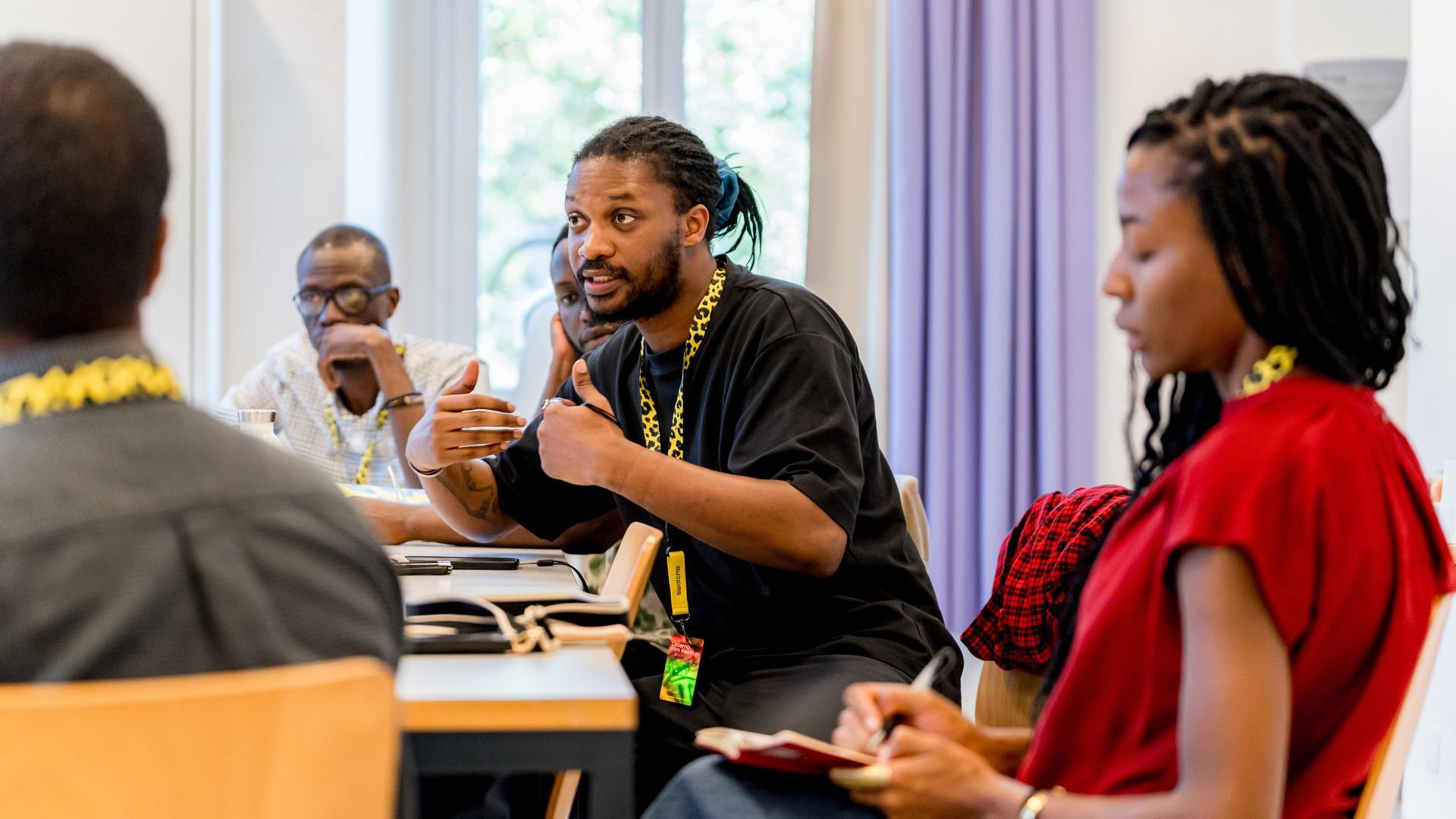
Open Doors, the Locarno Film Festival's professional development and co-production program, begins the second year of its four-year Africa Cycle on 5 August 2026. The edition runs until 10 August as part of Locarno Pro, the festival's industry platform in Locarno, Switzerland.
When I spoke with Head of Studies Yanis Gaye on 29 July 2026, he said the selection process had changed little and that the program continued to use an Open Doors structure developed over more than 20 years. The principal revisions concern the design of individual sessions and, within the Producers strand, a clearer focus on developing production companies.
The initial online program placed more of the work in participants' hands. Each selected project received a group deep dive in which members of the Producers program supplied production assessments and directors responded to its artistic elements. The artistic team and outside consultants also contributed. Other sessions asked producers to test possible co-production arrangements and assemble market benchmarks from scattered quantitative and qualitative information.
"It's always good to start from a template that generates positive results and positive feedback," he said. He wanted to avoid running "a program where you have the impression that things get passed on, when that's not naturally the case."
Gaye described the program as "a small boot camp for the companies, for their projects." In our 2025 interview, he identified a workshop in which Producers participants assessed external project submissions as one of the first edition's most valuable sessions.
One Producers session covered the construction of a co-production. Working from a financing plan, participants considered several scenarios and how each would divide financing, rights and responsibilities among the companies involved.
Another session addressed what Gaye calls a weak point in African pitch decks: data and market benchmarks. "When you look for it, the data is there, the information is there. You just have to dig — which Europeans don't necessarily have to do, because they can just subscribe to various platforms and get access to some data," he said. Participants used what they found to construct "very singular benchmarks that don't just have a quantitative approach but also a qualitative one." His objective was to make sure "people were more activated than they were talked to."
The team also adjusted the Producers application to make clear that applicants were applying to be incubated with their companies, not to bring a slate of projects and collect visibility for them. Changes to the application and selection process must be set in September and October before the call opens in November. Selection takes several months, and the online program is designed from February to the end of April.
Gaye said the visibility generated by the first African edition brought additional applications, while AI increased the volume of application material without necessarily improving its quality. Even so, the team reviewed roughly the same number of applications as in 2025. "Using AI to complete an application is not the problem," he said. "The issue becomes when AI generates ideas and thoughts rather than trying to articulate them. That's a big thing we warn participants against. I'm not against AI at all — but it requires a level of sophistication."
Of last year's participants, "Kachifo (Till the Morning Comes)," directed by Dika Ofoma and produced by Blessing Uzzi of Nigeria's Bluhouse Studios, won three Open Doors prizes. On 7 April 2026, Institut français announced its selection for La Fabrique Cinéma, a development program that connects first- and second-feature projects from Global South countries with film professionals during the Cannes Film Festival. On 18 June 2026, the Norwegian Film Institute, Norway's national film agency, awarded the project NOK 600,000 (about $63,000) in Sørfond production support, with DUOfilm attached as Norwegian co-producer.
"Black Snake," directed by Zimbabwean filmmaker Naishe Nyamubaya and produced by Sue-Ellen Chitunya of 263 Reels Productions, received the largest Open Doors cash grant on 12 August 2025: CHF 25,000 (about $31,000). Sundance Institute's announcement in January 2026 named Nyamubaya a writer-director fellow for its Screenwriters Lab, held from 17 to 21 January 2026.
Other 2025 participants later advanced projects or joined professional programs. The Ji.hlava International Documentary Film Festival in the Czech Republic lists Ethiopian producer Nahusenay Dereje as a participant in Emerging Producers 2026. His festival profile describes the feature version of "The Fortunate" as being written for a planned 2027 premiere.
Angolan producer Kamy Lara took part in Rotterdam Lab 2026, the producer-training program operated by IFFR Pro, the industry division of the International Film Festival Rotterdam. Her feature "Vanda" received a €5,000 development award from Atlas Workshops, the project platform of the Marrakech International Film Festival in Morocco, in December 2025.
In January 2026, "The Headstone," directed by Henok Legesse Birhanu and produced by Ethiopian producer Leul Shoaferaw, was selected for the Feature Films Program operated by Saudi Arabia's Red Sea Film Foundation.
Meanwhile, "Death and Its Friends," by Zimbabwean producer and screenwriter Kudi Maradzika, was selected for the Wscripted Cannes Screenplay List on 26 May 2026. The annual list presents feature screenplays by women and non-binary writers to film professionals during the Cannes film market in France.
Gaye puts this year's participant count at 27, against 29 in 2025, and expects Open Doors to support around 30 people in each of the remaining two editions. He wants the cycle to represent as much of the continent as possible and to provide access to people he calls "ecosystem builders."
"We have two more years to go, so we fit into a very finite frame," he said. "But I also think it's good, because then it's up to the rest of the African ecosystem to figure itself out. You can only do your part." The people involved will not disappear when the cycle ends, he added. They will carry what the four editions produced into their subsequent work, organizations, and programs.
Open Doors Connect, introduced in 2026, works with partner organizations that select and support creative producers from their respective focus countries or areas. Its first participants come from Benin, Madagascar, Brazil, and Mongolia.
African Film Press (AFP), the cross-regional alliance formed by Akoroko, Kenya-based publication Sinema Focus, and Nigeria-based publication What Kept Me Up, joined Open Doors in 2026 as an award partner. Our Critics Prize will provide one selected short film with US$500, a certificate, and continuing editorial coverage. "Whenever a program, especially a program that comes from a European region, tries to come and say, 'we're going to do something with and for the continent,' usually the 'we' becomes more of a buzzword than something that is actually being activated," Gaye said. "Trying to live by those words is very important for us." He pitched the AFP Critics Prize to Head of Open Doors Zsuzsi Bánkuti in year one, but our introduction of it came late in the cycle, and there wasn't time to land inside their program. It was also our first year. "This time I was determined that it needed to happen," Gaye added.
He placed the Open Doors Africa Cycle's principal risks outside the artistic team, which has "very little power over" them. "The only thing we can do is maintain as much as possible the independence with which we've been able to act for the past couple of years," he said.
Asked how Open Doors fits into his own engagements, Gaye said his work with Yetu (Un)Limited has certainly shaped the program. He co-founded Yetu in 2023 as a film studio comprising five African production companies. The studio has a four-year agreement with Locarno and participates in the co-curation of the Africa Cycle. Open Doors, he said, is "becoming proof that we as Yetu were able to assemble a structuring B2B type of partnership with a major market and deliver something cohesive to it" — a format he wants to replicate. He said two reasonably successful years had created time for Yetu's next phase, including its production company development initiative, Nomadic Film Space.
I put to him what I continue experiencing as pessimism rooted in frustration and fatigue among professionals in African spaces, amid global industry uncertainty. He said he sees it and understands it, and is optimistic anyway.
"That optimism comes from the fact that I am working in African markets — and I emphasize markets with an 'S'," he said. He points to new business models and to production companies doing several things at once, including their own marketing and distribution — for Yetu, he said, a de facto model.
He gives the present period of international interest in African film markets another three to four years. "Usually, those windows followed the same routine: 'Oh, Africa is hot right now. Let me get involved in one or two projects.' Then you never hear anything more about it. There's no continuity. What we are seeing now is a much more sustainable approach."
He cited our reporting on the theatrical earnings of "My Father's Shadow," Akinola Davies Jr.'s Nigerian family drama, and a benchmarking exercise of his own on the French market that he says shows several African films performing above commercial expectations. He argued that repeated performance across a group of films should be treated as a commercial reality, not a succession of isolated results.
On financing the commercial opportunity he sees in African film markets, he said: "As much as there is a lot of dumb money in this world, there is enough smart money to capitalize it. So we have to figure out what the pitch is." The not-so-simple part is what that requires of producers.
"We have to become much more professional and business-oriented than we should have had to be if there was more infrastructure around us. Because we need to be the infrastructure, be the policy, and even be the government sometimes."
When Open Doors 2026 begins in Locarno on 5 August, its 27 participants will enter a program designed for that expanded job description.
The jury awards this edition's prizes on 10 August, and the call for the third edition opens in November.