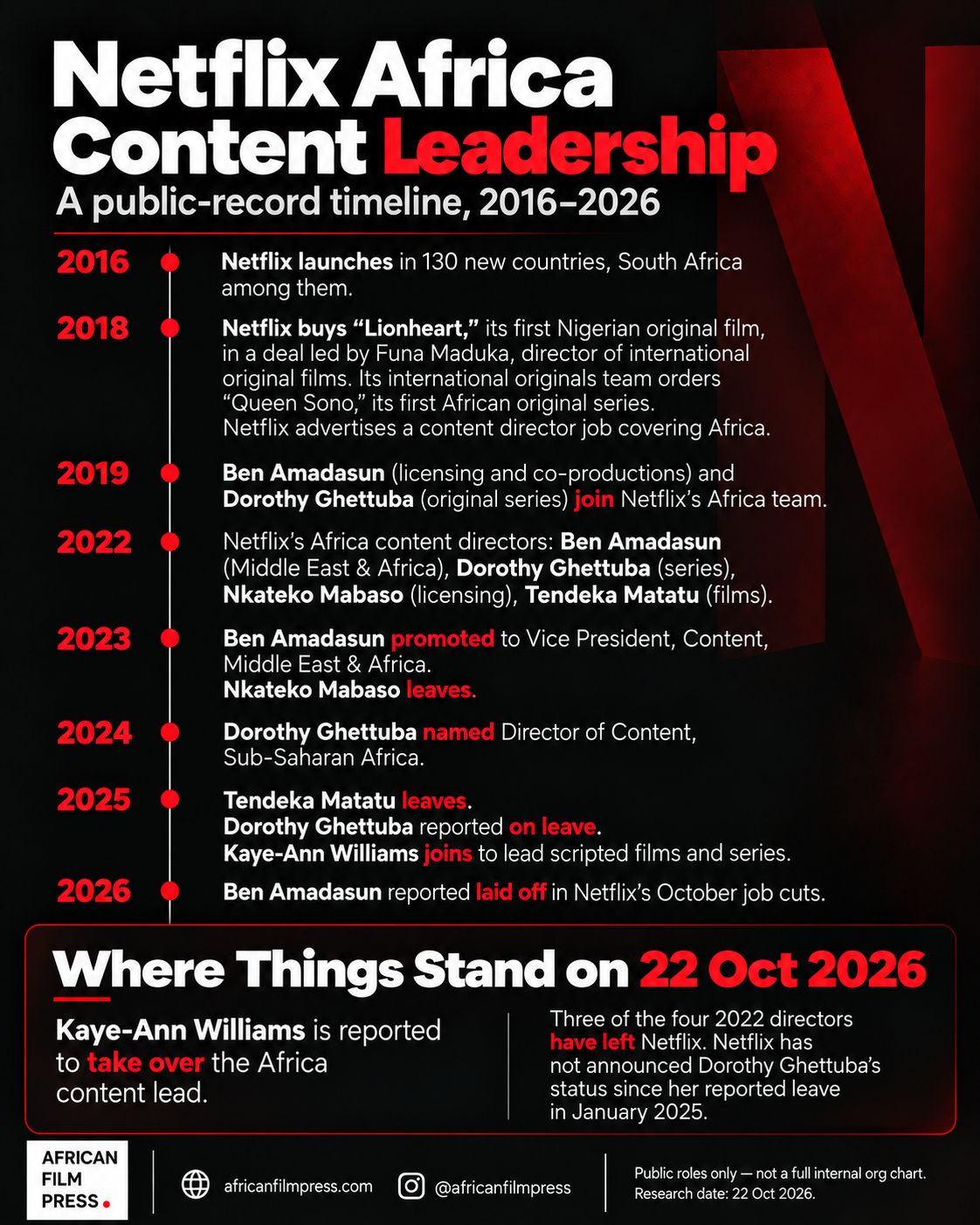
Netflix has reportedly laid off Ben Amadasun, its Vice President of Content for the Middle East and Africa, after seven years with the company. South African technology publication MyBroadband first reported the news on 20 October 2026. Earlier in October, Netflix told staff it would cut about 1,000 jobs worldwide, around 6% of its workforce. As of publication, Netflix had made no public statement about Amadasun’s exit.
Amadasun, who is Nigerian, led Netflix’s African content team from the company’s Amsterdam office. According to MyBroadband, he will not appear at MIP Africa and FAME Week Africa in Cape Town next week, a market where he has spoken in previous years. Kaye-Ann Williams, Netflix’s director of scripted content for sub-Saharan Africa, is reported to take over as lead for Netflix’s content strategy in South Africa and the rest of the continent.
Amadasun is the third senior Africa content executive to leave Netflix since 2023. In 2022, Netflix had four directors running its African content: Amadasun, Dorothy Ghettuba, Nkateko Mabaso and Tendeka Matatu. Mabaso left in 2023 and Matatu in 2025. Ghettuba was reported on leave in January 2025, and Netflix has not announced her status since.
Netflix went live across most of Africa in January 2016, when it launched in more than 130 new countries at once. In its first years on the continent, it offered African films and series that had been made for other outlets.
That changed in 2018. Netflix’s first original film from Africa was “Catching Feelings,” a South African romantic comedy, according to Funa Maduka, then Netflix’s director of international original films. In September 2018, Netflix bought “Lionheart,” the Nigerian film directed by Genevieve Nnaji, in a deal led by Maduka. It was Netflix’s first Nigerian original film. In December 2018, Netflix announced “Queen Sono,” a South African spy series starring Pearl Thusi, as its first African original series. The announcement came from Netflix’s international originals team. That same year, Netflix advertised for an Amsterdam-based director to acquire films and series from Africa, the Middle East and Turkey.
Netflix’s first executives dedicated to Africa arrived in 2019. Ghettuba, a Kenyan producer and co-founder of Nairobi production company Spielworks Media, joined in June 2019 to commission African original series. Amadasun joined the same year as director of content acquisitions and co-productions for Africa. “Queen Sono” premiered in February 2020. In June 2020, Netflix signed a multi-title deal with Nigerian producer Mo Abudu’s EbonyLife, which Abudu said she would deliver with Netflix teams led by Ghettuba and Amadasun.
By 2022, the team had four directors. Amadasun became director of content for the Middle East and Africa in June 2022. Ghettuba was director of series for Africa. Mabaso, a former chief executive of South African pay-TV channel group M-Net, joined that year as director of licensing and co-productions. Matatu, whose Netflix credits include the South African thriller “Heart of the Hunter,” was director of local language films. In August 2022, the four told Variety that Netflix planned to keep increasing its spending on African content.
The departures began the following year. Mabaso left Netflix by mid-2023 and was self-employed from June 2023, according to News24. He died in June 2024. Amadasun was promoted to vice president in August 2023, and in 2024 Netflix identified Ghettuba as its Director of Content for Sub-Saharan Africa. In January 2025, Deadline reported that Matatu had left after three years. Netflix hired Williams in a newly created role as director of scripted content, reporting to Amadasun, from February 2025. Williams had previously led scripted series and films for Prime Video in South Africa, until Amazon shut down its African original-content operations, and then briefly served as vice president of content at Primedia Studios. Before that, she spent years at MultiChoice and M-Net. The same week, journalist Thinus Ferreira reported that Ghettuba was on leave.
At a September 2026 event celebrating 10 years in South Africa, Netflix said it had worked with more than 30 South African production companies and supported more than 8,000 jobs. In an interview with MyBroadband published on 11 October, Williams said Netflix now makes 15 to 20 South African films and series a year, up from 8 to 12. That count includes fiction and non-fiction, and excludes shows Netflix licenses from others. She cited the South African series “The Polygamist,” which she said drew 24 million views in its first five weeks and entered Netflix’s Top 10 in 62 countries. Netflix co-chief executive Ted Sarandos singled the series out in the company’s second-quarter 2026 earnings presentation. Williams also said Netflix plans to invest in more stories from Africa, but named no countries, projects, budgets or timelines.
The increase follows the closure in 2026 of Showmax, the streaming service of MultiChoice, which Canal+ acquired in September 2025.
Netflix expanded into Nigeria and, on a smaller scale, Kenya between 2020 and 2023. From late 2024, it ordered considerably fewer new films and series in those markets, particularly in Nigeria. It has relied more on deals in which other companies sell Netflix, including a June 2025 agreement with Canal+ to bundle Netflix subscriptions in 24 French-speaking sub-Saharan African countries.
On the layoffs themselves, MyBroadband reported that apart from Amadasun’s exit, nothing else was changing, including Netflix’s level of investment in original African content. A source told News24 that Netflix’s Africa staff were not disproportionately affected by the cuts. According to News24, Netflix’s notice to staff reportedly said most of the affected roles were in product, technology, legal and human resources. The same round of cuts removed Netflix’s chief content officer, Bela Bajaria, who has been replaced by Peter Rice. In a memo to staff, Sarandos described the changes as an opportunity to improve Netflix’s slate, particularly in the United States and Canada.
Netflix is keeping its scheduled panel at MIP Africa in Cape Town next week, where Williams is due to speak.