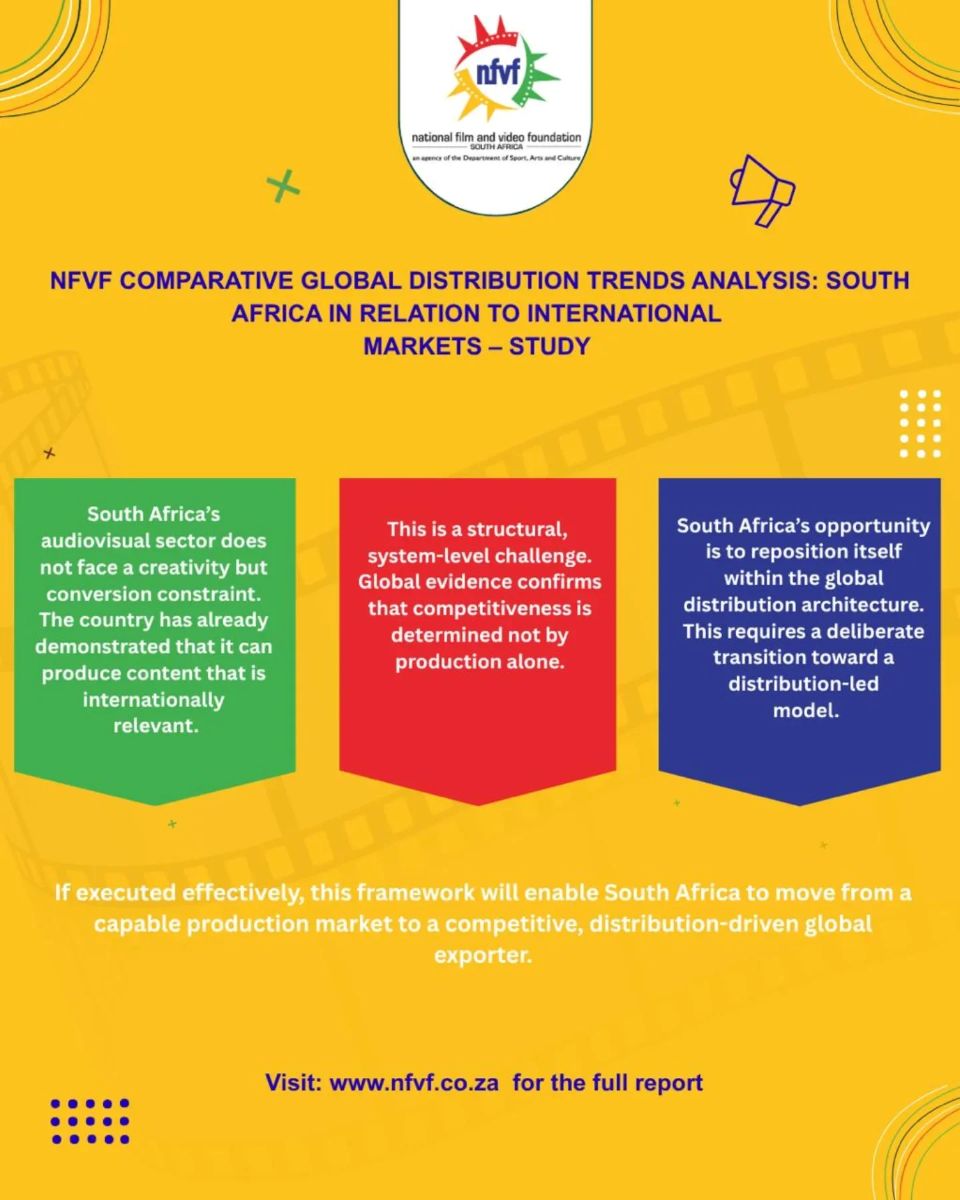
South Africa's National Film and Video Foundation (NFVF) — the government body charged with developing its film and video industry, under the Department of Sport, Arts and Culture — has released two 2025/2026 studies that back a lament the industry has aired for years: the country has strong production capacity but converts little of it into box-office share, international circulation, rights retention, or export earnings. Most South Africans surveyed say they can find South African content and would pay for it, according to the audience study, yet local films barely register at the box office. Explaining that gap is the job the two reports take on.
The South African Audience Research Report and the Global Distribution Trends Analysis Report were both made public on 18 June 2026, with full versions posted on the NFVF's website (nfvf.co.za) under the Research tab, produced by the research firm Birguid.
What the Box Office Shows
Start with the hard number. Local films accounted for just 0.9% of the total South African box-office gross in 2023, according to the distribution report, citing NFVF data. Cinema-going itself is fading: close to 80% of the people surveyed for the audience report had not been to a cinema in more than six months, or had stopped going altogether. For most respondents, the report concludes, the cinema is now an occasional outing for a special film, not a regular habit.
What Audiences Say They Want
The audience survey, which reached just 379 people across all nine provinces, finds plenty of stated appetite for local work. 78.6% said South African content is easy to find, 76% said they would pay for it, and 65.7% said they would pay the same cinema ticket price for a local film as for an international one.
Those are stated attitudes, but behavior says something else: people say they will pay, yet the films barely sell. Demand is real but apparently conditional, the report argues — essentially, audiences pay when a film looks worth it, and too often local films don't clear that bar, whether on quality, marketing, visibility, or trust, again, according to the report.
How South Africans Watch Now
The survey also looks at how South Africans watch, and most habits are a hybrid. It states that 71.8% watched television programmes or series, 62.3% watched films, and 61.2% watched short online videos. Just over half said those short clips now fill more of their day than longer films and shows. Almost all respondents are online at least weekly (94.7%), in a mobile-heavy environment where access is uneven and influenced by data cost.
On artificial intelligence, audiences are wary. Half held mixed views, 36.4% were mostly negative, and 38.3% said AI is not acceptable at all as a stand-in for human creativity, though they accepted it in support tasks like marketing, script development, subtitling, and dubbing.
Strong at Making Films, Weak at Selling Them Abroad
The distribution report turns from audiences to the industry. South Africa, it argues, has built real skill at making films but little of the apparatus to move them into foreign markets or to hold on to the money they earn. It scores the country against the United States, South Korea, Brazil, and Nigeria on five measures — market access, distribution readiness, deal-making and value retention, infrastructure, and policy — and places it in the middle of that group: ahead of most African peers technically, behind the leaders on market access, rights retention, and export deals. South Korea and Brazil are held up as models for building export-minded institutions.
The report also identifies the unstable administration of South Africa's film incentives — late approvals, backlogs, and delayed rebate payments at the Department of Trade, Industry, and Competition (DTIC) — as a threat to competitiveness and investor confidence.
Where the Two Reports Agree
Neither report blames a shortage of content or audience interest. Both argue that South Africa has spent years learning to make films and far less on getting them to viewers and earning from them. They differ on where to push hardest — the distribution report on market access, deal-making, rights, and policy; the audience study on craft, packaging, marketing, and trust — but the shared message is to work both ends at once: the films and the channels that carry them.
Their common to-do list includes cheaper mobile-first delivery, social-media-ready marketing, subtitling and dubbing, tighter control of rights, and a film-incentive scheme that pays on time.
So What?
Little in the diagnosis will surprise people who work in South African screen media: weak distribution, thin marketing, leaky rights, unstable incentives, and falling cinema attendance are long-standing concerns.
The data in both reports might prove more valuable to those outside that ecosystem.
That said, none of this is the final word, and, to be fair, neither report claims to be. The distribution report is based on interviews with industry experts; the audience survey, with 379 respondents, is designed to show trends, not exact proportions. These studies give the state film body a directional read on the bottlenecks, detailed enough to inform policy and spending.
Download both reports here under the "Industry Insights" section.