I began pulling this material together after realizing that Netflix's global rollout reached Africa on January 6–7, 2016. Today is January 17, 2026, almost exactly ten years later. That milestone passed rather quietly, without any anniversary framing from Netflix — although there might be something ahead — but it felt like a natural moment to pause and take stock, particularly from an Africa-focused perspective.
My initial plan was to keep this as an internal working document for Akoroko and African Film Press (AFP). A far more detailed version exists, tracking nearly every identifiable marker across the decade. But looking back at developments across late 2024 and 2025 as captured by Akoroko — Netflix's earnings silence on Africa, the question of whether we had reached what I called "the end of the thread" in late 2025, the Canal+ acquisition of MultiChoice, and the changing shape of the African pay-TV and streaming landscape heading into 2026 — I realized that a consolidated, high-level version was also worth sharing with Premium subscribers.
This is a reflection of how Akoroko has increasingly worked more broadly: building and maintaining long-running archives so that moments like this can be assessed with continuity.
This dispatch is written with an eye toward how the back half of the 2020s is beginning to take shape as the industry moves toward 2030. What follows is intentionally restrained and chronological, designed to establish a stable reference point before the next phase of platform strategy, consolidation, and market repositioning begins to unfold within Africa specifically.
Why This Matters Now
Netflix opened subscriptions and streaming access in many African countries in January 2016. Ten years later, in January 2026, the company's commissioning activity in Africa is bound to one country — South Africa. At the same time, access to Netflix in many other African markets is increasingly handled via distribution partnerships. At the same time, producers, financiers, regulators, and distributors are making concrete decisions about where to work, how to structure deals, and which platforms still matter.
This report lays out, in order, how Netflix's operations, commissioning, and distribution in Africa changed between 2016 and January 2026. It consolidates a decade of reporting and analysis (including three years of Akoroko insights), aligning dates, investments, titles, partnerships, regulatory encounters, and market behavior into one continuous account.
Phase I — Global Switch-On Without Local Fit (January 2016 to 2019)
On January 6–7, 2016, Netflix enabled service access across 130 countries, including virtually all African states. Pricing generally matched United States and European subscription levels; payment depended on international credit or debit cards; delivery relied on servers located outside Africa; and catalog depth skewed toward United States and European titles.
From 2016 to 2019, Africa functioned primarily as a territory where existing films were licensed rather than newly commissioned. Early acquisitions included South African and Nigerian features, culminating in the 2018 acquisition of "Lionheart" (Nigeria), its first.
Hiring regional leadership in 2018 suggested an internal shift toward local knowledge, creating the conditions for Netflix's first commissioned African series.
Phase II — Commissioning Surge and Visibility (2020 to 2023)
February 28, 2020, saw the premiere of "Queen Sono" (South Africa), the first commissioned African original series. In May 2020, "Blood & Water" (South Africa) premiered and achieved sustained global viewership.
Between 2020 and 2022, licensing and commissioning activity expanded across South Africa and Nigeria, with Kenya serving as a smaller test market.
During this period:
- Nigerian releases included "Òlòtūré," "Citation," "King of Boys: The Return of the King," "Blood Sisters," and "Aníkúlápó."
- South African output stretched into multi-season series and higher-budget feature films.
- July 2023 saw the release of "Supa Team 4" (South Africa), the first African animated series on the platform.
On October 14, 2021, Netflix announced a partnership with UNESCO for "African Folktales, Reimagined," a short-film initiative involving multiple African filmmakers.
By 2022, publicly stated cumulative spend across South Africa, Nigeria, and Kenya reached approximately $175 million (about €160 million at the time).
The 2020–2023 window was the period of highest investment intensity for Netflix in Africa — "The Golden Years," as it were.
(South African feature "Heart of the Hunter" — the first-ever Netflix African film to reach #1 in the Global Top 10 for English language titles, in 2024)
Operational adaptations addressed affordability and access:
- Mobile-only plans rolled out widely in 2021, offering lower-priced subscriptions limited to smartphones.
- Kenya hosted a free mobile plan experiment from September 2021 until November 2023, allowing users to watch a limited catalog without payment.
- Select telecom billing integrations launched in South Africa and Kenya, enabling subscription charges to be added to mobile phone bills.
Phase III — Recalibration, Concentration, and Partnerships (2024 to January 17, 2026)
The 2024 and onward period saw a readjustment phase. Commissioning volume declined relative to the prior period, with the sharpest effects felt in Nigeria. Industry testimony referenced cancelled or paused development slates during late 2024, meaning projects in development did not move forward to production. Public statements framed the shift as tighter selection criteria.
By the second half of this stage, investment and operations concentrated overwhelmingly in South Africa:
- South Africa absorbed the majority of content spend, production infrastructure, and subscribers.
- Nigeria retained cultural visibility with existing titles yet faced reduced commissioning momentum, as fewer new projects entered development.
- Kenya remained very limited in scale and functioned mainly as a licensing and mobile-tier market.
Competitive pressure intensified:
- By late 2023, Showmax (MultiChoice) surpassed Netflix in African subscriptions, supported by sports rights, local-language programming, and integrated payment systems.
- Of course, Amazon Prime Video withdrew from commissioning new African original productions in early 2024, following a broader global reduction in original content spending.
Netflix's distribution strategy pivoted toward bundling:
On June 6, 2025, French media giant Canal+ and Netflix announced the expansion of their European partnership into Sub-Saharan Francophone Africa, structured as Netflix access bundled inside Canal+ subscription packages across 24 countries. The arrangement positioned Canal+ as the customer-facing distributor, meaning Canal+ managed subscriptions, billing, and customer relationships, while Netflix supplied its catalog into the bundle.
The pivot aligned with the consolidation of large media groups primarily in the West.
In September 2025, Canal+ completed its acquisition of MultiChoice, Africa's largest pay-TV provider, forming a combined group with services across satellite television, broadband, mobile access, and streaming platforms, and its strongest operational base in South Africa.
Netflix's Q3 2025 earnings materials and call commentary included no Africa-specific discussion. This absence aligned with Africa's reduced visibility inside Netflix's investor-facing growth narrative throughout its African "experiment" run, while the Canal+ partnership functioned as a distribution path that limited Netflix's need to build or maintain direct customer relationships, at least in Francophone African markets.
In parallel, Canal+ articulated its own post-acquisition content and distribution rationale. In October 2025, Canal+ executives described Studiocanal's role as an export and international sales engine for group-produced content, including African series and films. A subsequent interview published in November 2025 outlined how Canal+ planned to organize commissioning priorities, production hubs, and international distribution following the MultiChoice acquisition.
By late December 2025, Akoroko assessments of Canal+ / MultiChoice communications suggested early-2026 continuity: consumer brands retained, operational systems unified, and aggregation interfaces positioned to place Netflix inside broader bundles in territories where Canal+ distributes Netflix access.
Additional distribution developments:
- In July 2025, Netflix further bundled its services with Saudi Arabian content-streaming platform MBC Group's Shahid to extend its reach across Arabic-language markets in North Africa and the Middle East.
- In January 2026, Netflix partnered with the Confederation of African Football for the AFCON 2025 daily highlights show, in its first structured sports-related distribution agreement in Sub-Saharan Africa.
Economics, Scale, and Market Position
Netflix has never officially disclosed its Africa subscriber numbers; instead, estimates rely on indirect indicators, including pricing, partner disclosures, and extrapolation from overall platform reach.
- Early 2020s: approximately 1.8–2.6 million subscribers across Africa.
- By 2025–2026: broader estimates range higher when bundling reach in Francophone and North Africa (Canal+ and MBC/Shahid) is included.
In both scenarios, South Africa accounts for the majority of direct, individually paid subscriptions.
Across this period, for Netflix, Africa represents a region with low average revenue per user, subject to currency volatility. Nigeria, Egypt, and South Africa experienced repeated price adjustments during 2024–2025. Economic constraints, data costs, and power reliability shaped viewing trends and limited mass-market scale.
Regulation and Policy Exposure
Regulatory engagement appears most extensively in South Africa:
- Public and regulatory discussions in South Africa between 2021 and 2025 concerning whether streaming platforms should be required to meet local content quotas and contribute financially to domestic production funds.
- Film and Publication Board requirements that streaming platforms register content and pay licensing and classification fees for audiovisual works made available to South African audiences.
Kenya and Nigeria each presented periodic regulatory pressure around content standards and broadcasting codes (depiction of drugs and alcohol, violence, offensive language, sex, nudity, etc), addressed with enforced local policy.
Cultural Reception and Critique
This period also saw sustained debate around:
- A perceived "Netflix African aesthetic," rooted in its "local first" strategy.
- Power imbalances in commissioning and rights ownership.
- Crisis moments, including backlash to "Chief Daddy 2" (Nigeria, 2022) and the international representation dispute surrounding the "Queen Cleopatra" (2023) docu-drama series.
At the same time, multiple titles reached global circulation, reinforcing Netflix's role in exporting selected African stories to worldwide audiences.
Consolidated Assessment at the Ten-Year Mark
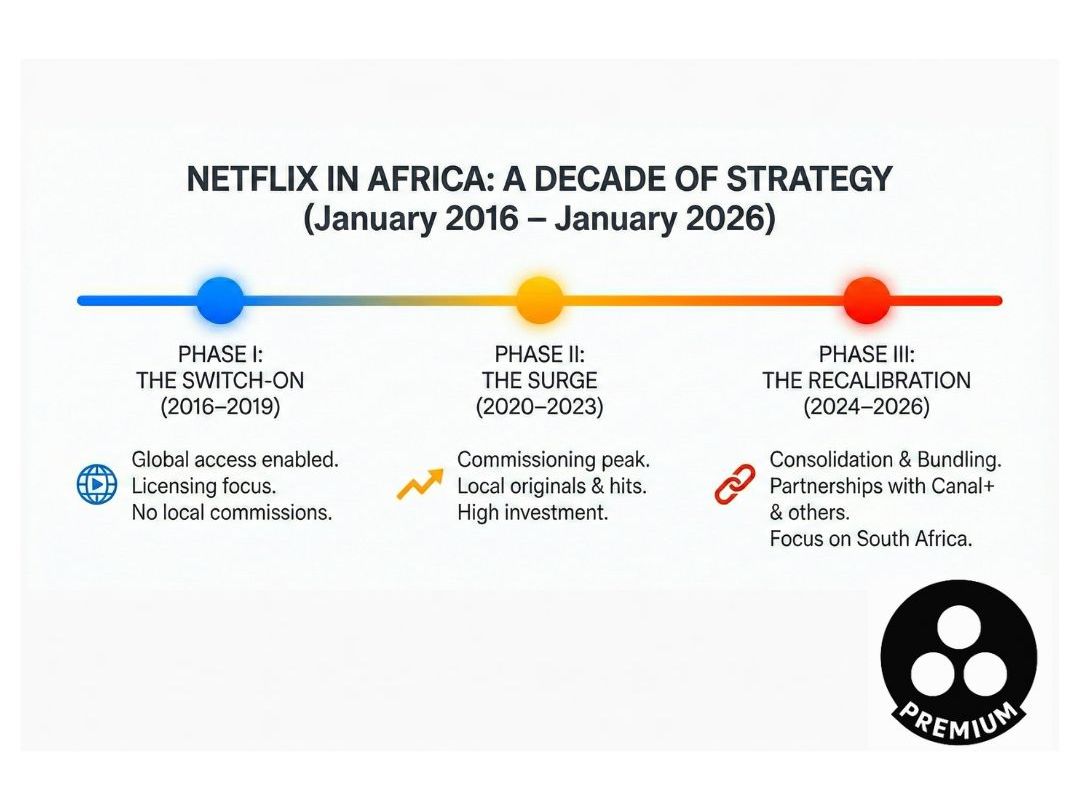
Across these ten years, Netflix's operations in African markets moved through three distinct phases:
- 2016–2019: Netflix provided access to its service in African countries but had limited local pricing sense, payment integration, infrastructure investment, or commissioned local content.
- 2020–2023: Netflix increased direct commissioning of African films and series, particularly in South Africa and Nigeria, and several titles reached global audiences.
- 2024–2026: Netflix reduced overall commissioning activity, concentrated spending and operations primarily in South Africa, and relied more heavily on distribution partnerships to reach audiences elsewhere.
As of January 17, 2026, Netflix's operations in Africa are concentrated in South Africa, maintain international visibility with previously released titles, face limits linked to infrastructure and affordability, and depend on established regional media groups to extend access beyond English-language markets.
And with that...
This dispatch closes a first decade-long chapter by laying out a consolidated public record drawn from a much more granular internal archive of events, decisions, and shifts that are already shaping the next one.
As platform strategies, distribution models, and the contours of markets continue to shift across the back half of the 2020s, subsequent developments in 2026 and beyond can be read against this record.