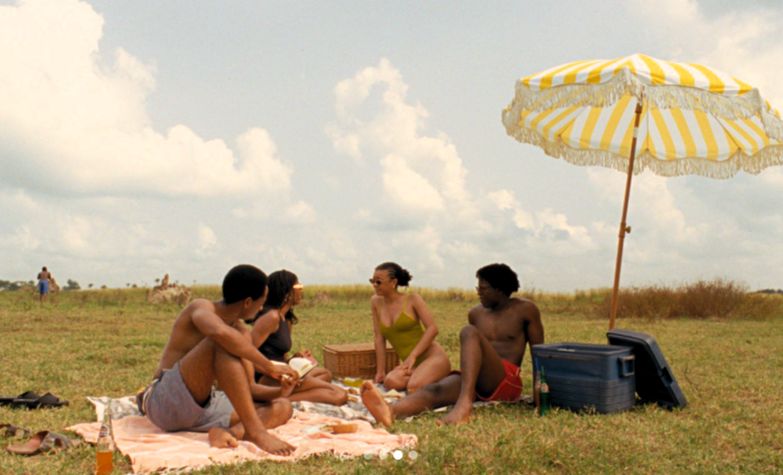
Filmmakers Chuko and Arie Esiri describe "Clarissa," the follow-up to their working-class first feature, "Eyimofe" (2020), as a free variation on Virginia Woolf's 1925 stream-of-consciousness novel, "Mrs. Dalloway," made from two impulses at once: an interest in Woolf's novel and a desire to explore a specific Nigerian social stratum. In a post-screening Cannes Film Festival Q&A, where the film is making its world premiere, they also connect the adaptation to Nigeria's colonial history with England and their interest in capturing a high-society Lagos milieu rarely seen on screen.
The film moves between present-day Lagos, where Clarissa prepares for a party at her home, and an earlier timeline that follows Clarissa, Peter, Sally, Richard, and others in their youth. Sophie Okonedo plays the older Clarissa, with India Amarteifio as the younger version; David Oyelowo plays the older Peter, with Toheeb Jimoh as the younger; Nikki Amuka-Bird plays the older Sally, with Ayo Edebiri as the younger; Jude Akuwudike plays the older Richard, with O Ogranya as the younger Richard; and Fortune Nwafor plays Septimus, a soldier who has PTSD.
During the Q&A, Chuko, who wrote the screenplay, said he reread "Mrs. Dalloway" eight or nine years before adapting "Clarissa" and recognized his own family and social circle in Woolf's characters. The film follows that recognition into Lagos. Woolf's upper-class London world, old attachments, and class anxieties become an upwardly mobile Nigerian circle where privilege is expressed in British accents that suggest elite education, international travel, and inherited British class principles, even as they move inside Nigerian domestic hierarchies; cooks, drivers, housekeepers, workers, and service standards strict enough for a father to scold a servant for serving without gloves.
That dynamic complicates any surface reading of class in "Clarissa" as a Lagos-set adaptation of "Mrs. Dalloway." Consequently, the film is strongest as a study of class behavior within an upper-crust Nigerian socio-cultural environment in which speech, physical spaces, labor, cuisine, manners, and inherited British codes define the social order.
The opening sequences, setting up the party preparations, establish the terms: in the "older" timeline, Richard, Clarissa's husband, has invited "Sandra" to the party without Clarissa's approval, and Clarissa tells him to withdraw the invitation because the guest list is hers to control; the wrong plates have been brought out; the unclean mosaic has been left against the sofa; Mr. Joseph, the workman, has to move it; Matilda, one of the household staff, has to recheck the kitchen, to make sure there is snail and guinea fowl; Comfort, another staff member, is summoned and corrected; Ellie, Clarissa's daughter, is told to eat upstairs or outside because Clarissa doesn't want anyone in the main space before dinner.
Those commands are practical, direct, and constant. "Clarissa," the film, understands that class power often appears as the right to be particular. Clarissa does not need to shout. She asks, corrects, redirects, and expects compliance without confrontation. When Mr. Joseph explains that the wall-mounted mosaic looks different from his height than from Clarissa's, after she summons him in frustration, her answer — "Hang it at my level" — carries more weight because the word references both the placement of the artwork itself and the hierarchy inside the house.
Chuko Esiri stated that Nigeria's colonial history with England made Woolf's material feel even more relevant to the adaptation. The film turns that history into social behavior. Clarissa's home is more than background. It's the film's most precise social space.
The younger timeline sharpens that order. In an earlier uncomfortable scene in which Clarissa's father sharply scolds a servant for serving without gloves in front of the younger Clarissa, Peter, Richard, and Sally, social class becomes a lesson. The children are being served, but they are also being educated in how their world functions. The discomfort of the scene comes from the fact that everyone involved is Nigerian, while the terms of respectability appear shaped by an imported etiquette system.
In that same younger timeline, a conversation about a poem Peter, an aspiring writer, has written turns into an argument about colonial language. Peter says the poem is about colonialism and the discord it created. Clarissa challenges his use of words like "raw" and "primal," because those words make Africans sound backward. Peter argues that the early imagery was meant to suggest an uncluttered life before colonial disruption. Clarissa refuses that defense: "Words have meaning." If he uses a word like "primal," she says, the reader will imagine something "rough and unrefined." He cannot ask the reader to reclaim the word for him.
At this point, "Clarissa" becomes more than a mere literary adaptation. In Woolf's novel, Mrs Dalloway's social class is the unmarked default — the inside that the novel watches from. In the Esiris' film, that class is visible as a Lagos social stratum that Nigerian cinema, made for international circulation, rarely places at the center. The film's social intelligence does not turn the point into a lecture. It lets it accumulate in speech, posture, service, correction, and silence.
That restraint is also the film's limitation. "Clarissa" is, for all intents and purposes, a mood piece, organized less by plot than by feeling and atmosphere. That choice gives the film its visual distinction, but it also leaves parts of the drama feeling underdeveloped. It's titled "Clarissa," and Okonedo's older Clarissa is often compelling to watch, yet the film gives fuller access to her environment than to her interior life. By the end, we know her class position, her marriage to Richard, her daughter, her party, her old attachments, and her need for control. We understand how she arranges a room. We understand less about what she wants from the life she has arranged.
The film spends enough time away from the character Clarissa that "Clarissa" feels more like an ensemble piece organized around a party than a character study anchored entirely in her point of view. The uncertainty may be part of the film's design, but it still shapes the viewing experience: Clarissa is always present as a social force, while her desire is harder to identify.
Okonedo does a great deal with that limited access. Her face becomes one of the film's most expressive surfaces. The camera often holds on the slightest shifts: a smile that does not fully settle, a look away, a moment of concern, a brief sign of strain inside a composed body. Clarissa's dresses hang on her in a way that makes her seem both elegant and exposed. Her stillness has authority, but also a kind of fatigue. The performance gives the film many of its finest moments because Okonedo can make withheld feelings visible without having to explain them.
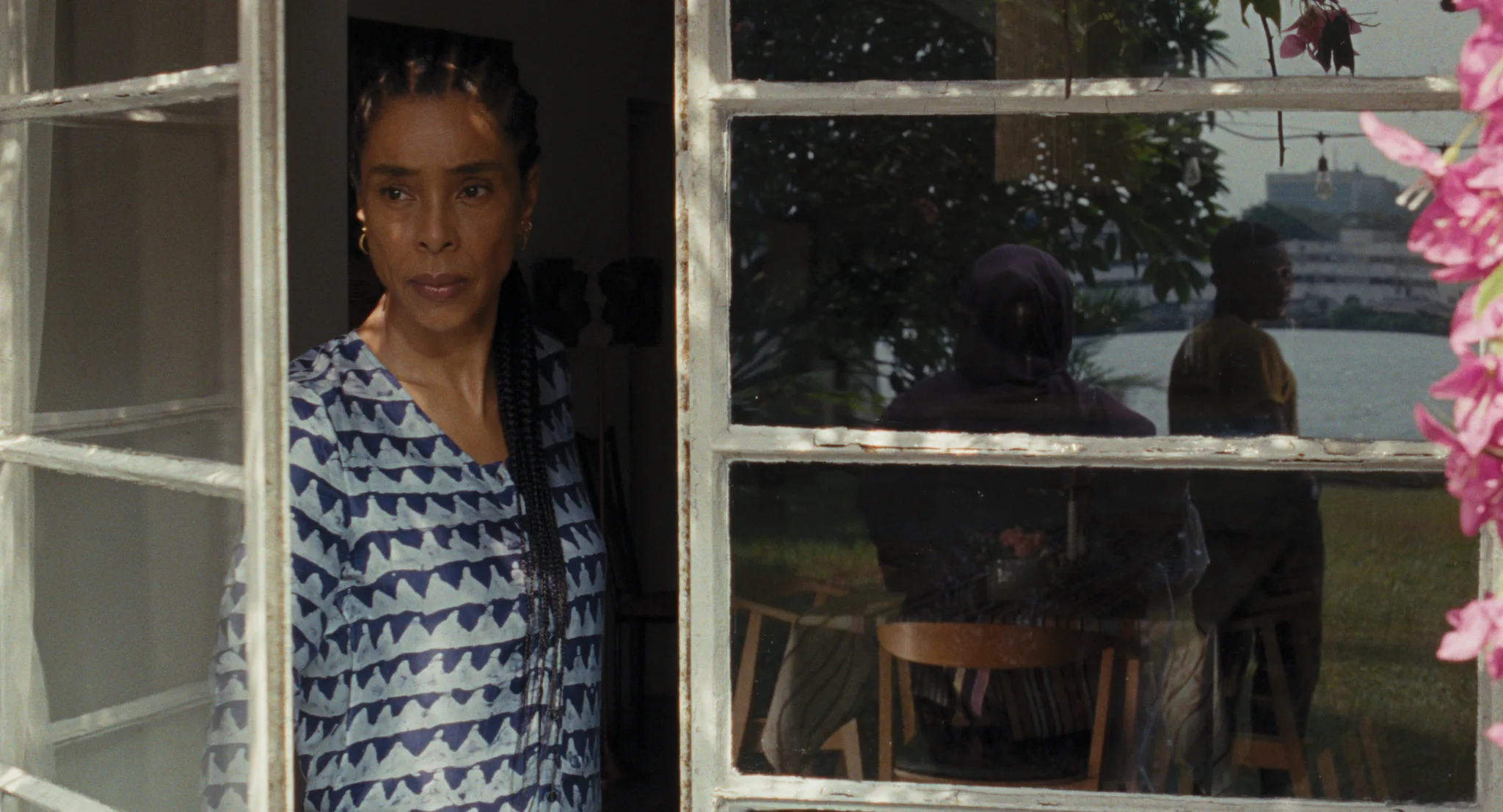
Jonathan Bloom's cinematography supports that performance. "Clarissa" is visually warm, controlled, and carefully framed, often using the house itself to contain people inside lines, doorways, and interior arrangements. The past has a softer, more idyllic quality than the present, with youth, beauty, ennui, and privilege treated almost as a remembered atmosphere. The younger sections feel insulated from ordinary Lagos life; the present-day scenes feel more arranged, as if memory has hardened into rooms, objects, etiquette, and routine.
Lagos is also filmed against the usual screen shorthand. "Clarissa" does not lean on traffic, heat, noise, or urban anxieties. It presents a Lagos of compounds, interiors, measured movement, and expensive calm. It's still Lagos, but Lagos from a particular class position.
That visual restraint gives "Clarissa" its beauty, and sometimes its drift. At 125 minutes, the film's quietness begins to feel overextended. A work organized by mood can hold attention when every scene deepens the central experience. Here, several passages draw out the atmosphere without adding enough new tension to Clarissa's story, making its structural looseness harder to ignore.
The Septimus storyline is where that structural looseness becomes most difficult to resolve. The Esiris' reasoning is sound: Woolf's Septimus, a First World War veteran, becomes a soldier who has PTSD after Nigeria's conflict with Boko Haram and related armed groups; Big Ben, which tracks the single day of "Mrs. Dalloway" and keeps the characters aware of time passing, even as memory and fear of death interrupt the present, becomes the adhan, the Muslim call to prayer heard in the film's soundscape. "Clarissa" also seems to lead into Septimus's story with a modified "Twinkle Twinkle Little Star" that appears to fold in English folk-rock singer and songwriter Sandy Denny's 1968 recording, "Who Knows Where the Time Goes?," a song about time, memory, and departure (a Nina Simone cover if my memory serves me). The added line — "How can we know when it's time to go before the winter fire and the stormy sea?" — brings mortality to the fore as the soldier's strand begins. The transpositions are specific: Woolf's war trauma becomes present-day Nigerian military trauma, and Big Ben's chimes become the adhan and a modified lullaby. The problem is execution. Septimus has a strong reason to be in the adaptation, but the film gives his story less dramatic attachment to Clarissa's day than Woolf's novel does on the page, where Septimus's world enters her stream of consciousness. "Clarissa," the film, seems to keep the Woolf structure primarily because the adaptation requires it, while the Lagos class portrait has its own rationale and strength.
The same restraint shapes Clarissa and Sally's past intimacy. In the novel, Clarissa Dalloway remembers Sally Seton as one of the defining emotional connections of her youth, with their kiss surviving in memory after Clarissa's marriage, motherhood, and social position have shaped her adult identity. Woolf's adult Sally returns as a married mother whose youthful defiance has been folded into domestic respectability; the film gives adult Sally motherhood without making her feel equally settled. It keeps the memory of their desire, but its translation is subdued. In the younger timeline, their closeness leads to confirmation of their desire without dramatics. In the present, that past is an undercurrent during their adult encounter at Clarissa's house. The film does not resolve what they were to each other. It lets the memory remain part of the emotional pressure around the party.
The film is also delicate about the diaspora-returnee narrative in Lagos. Clarissa and the characters from her social setting are not foreign to Nigeria, but the film often presents them as Nigerians whose speech, education, and mobility set them apart from the workers and relatives who measure belonging differently, often by service, presence, obligation, and daily proximity to the house. The older Peter's return to Lagos places him before an aunt who makes that distance more concrete. She chides him for coming to town without calling her, reminding him that return still comes with family expectations: "It's not polite."
As a Nigerian (and Cameroonian) in the wind, some of Clarissa's household order felt familiar to me: the domestic workers, the drivers, the people who maintained the compound, parental expectations, mobility, and the way middle- and upper-class Nigerian homes could make domestic labor feel ordinary until a film places it back in direct view. From that position, I can see moments when the film's restraint edges toward social comedy, especially in rituals like hosting, correcting, waiting, and preparing. Luis Buñuel's 1972 surrealist satirical dark comedy, "The Discreet Charm of the Bourgeoisie," comes to mind, though only as a loose reference point. "Clarissa" is much softer, but it sometimes feels like it's observing its British-accented Nigerian elite via the ritualized absurdity of keeping a party, a house, and a social image in order.
In the end, "Clarissa" gives us a woman shaped by taste, memory, marriage, social obligation, and authority. Woolf's novel gives Clarissa Dalloway direct interior life: thoughts about age, marriage, Sally, Peter, death, memory, and the life she has chosen. The film works from the outside, using Sophie Okonedo's face, the house, old friends, silences, and gestures to show what Woolf offers the reader as thought. That choice helps explain both the film's strength and its limit.
The Esiri brothers' "Clarissa" is most persuasive as a window into bourgeois Nigerian life with a British-Nigerian layer: a world of privilege, mobility, servants, controlled spaces, estates, options, and social codes that are rarely handled with this much intentional, almost ethnographic observation from both the inside and outside, dependent on a domestic order that the film observes with intelligence, even as Clarissa herself stays more elusive than the world built around her.
"Clarissa" world premiered in Directors' Fortnight at the 2026 Cannes Film Festival. Directed by Arie Esiri and Chuko Esiri; screenplay by Chuko Esiri; based on Virginia Woolf's "Mrs. Dalloway". Per Capita Productions, Inc. and Invention Studios are producers; sales by Neon; international press by DDA.