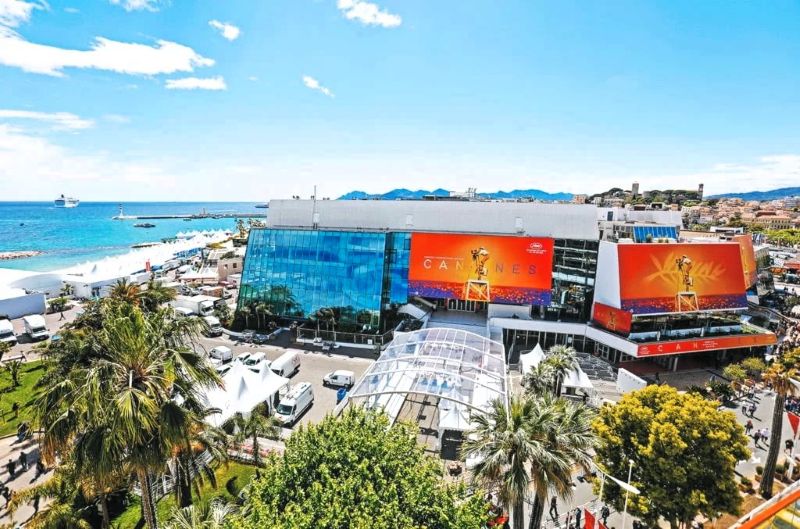
The 79th Cannes Film Festival opens today and runs through May 23, with the Marché du Film alongside it from May 12 to 20. Much of the Official Selection has been announced, and the Marché's 2026 conference program is out. Together, they give a clear view of Africa's presence on both sides — festival and market.
This year's lineup is best read against a longer record. Akoroko's tracking already showed that, by the end of 2024, the 2020s had become the strongest decade on record for African feature selections at Cannes, with first-time entries from countries including Sudan, Somalia, Zambia, and the Democratic Republic of the Congo. Cannes 2026 adds to it. The festival has historically concentrated African selections in a much smaller group of countries, especially Egypt, Morocco, Senegal, and Tunisia.
At the Festival
No African Films in Competition
None of the 21 main Competition films are directed by African or diaspora filmmakers, nor do they tell African stories. That's a step back from the three selected for Cannes 2025.
Akoroko's historical Cannes data also shows that African films have often reached the festival via Un Certain Regard, Directors' Fortnight, and International Critics' Week — key entry points outside the main Competition.
Across the Official Selection and the parallel sections, Africa accounts for six titles: three in Un Certain Regard, one feature and two shorts in Directors' Fortnight.
Official Selection short films have not yet been fully announced, but I don't expect that to shift these results materially.
Un Certain Regard:
- "Congo Boy" (Rafiki Fariala) — Central African Republic / DRC / France / Italy
- "La Más Dulce" (Laïla Marrakchi) — Morocco / France / Spain / Belgium
- "Ben'imana" (Marie-Clémentine Dusabejambo) — Rwanda
Directors' Fortnight:
- "Clarissa" (Arie Esiri and Chuko Esiri) — Nigeria / UK / US [feature]
- "Nothing Happens After Your Absence" (Ibrahim Omar) — Sudan [short]
- "À La Recherche De L'Oiseau Gris Aux Rayures Vertes" (Saïd Hamich Benlarbi) — Morocco / France [documentary short]
The Films
"Congo Boy" follows 17-year-old Robert, a Congolese refugee living in Bangui in the Central African Republic, who is left to care for his four younger siblings after both parents are imprisoned. He juggles daily life, odd jobs, school exams, and concert stages, holding onto his dream of a music career. The film is heavily autobiographical. Fariala himself arrived in the CAR as a child refugee from the DRC, launched a music career in Bangui in 2013, and entered filmmaking via Ateliers Varan, a Paris-based documentary training workshop that has run programs in Bangui since 2017. International sales: The Party Film Sales (Paris).
"La Más Dulce" (English title: "Strawberries") follows Hasna, a Moroccan woman who leaves home to work as a seasonal strawberry picker in Huelva, Spain. Her dream of financial independence collides with abuse, harassment, and inhumane working conditions. Hasna and her companions decide to fight back, with the help of a Spanish lawyer. The film was inspired by a group of women Moroccan fruit pickers in Andalusia who filed lawsuits alleging abuse by their employers. Shot between Morocco and several cities in Andalusia. Written by Marrakchi and Delphine Agut. Lead actress Nisrin Erradi is known for "Everybody Loves Touda" and "Adam." International sales: Lucky Number.
"Ben'imana" is set in Rwanda in 2012 and follows Vénéranda, a survivor of the 1994 genocide against the Tutsi who is deeply involved in community-led processes of justice and reconciliation. As she navigates mounting pressure in her work, a personal crisis within her own family forces her to confront the limits of her convictions. It is the first film by a Rwandan director to be selected for the Cannes Official Selection. "Munyurangabo" (2007), the only prior Rwandan Cannes title, was directed by Korean American filmmaker Lee Isaac Chung. Dusabejambo was born in Kigali in 1987, trained as an electrical and telecommunications engineer, and has been making short films since 2011, with multiple Tanit Bronze awards at Carthage and festival wins in Zanzibar and Madagascar. International sales: mk2 Films.
"Clarissa" is a contemporary reimagining of Virginia Woolf's "Mrs. Dalloway," set in Lagos. Society woman Clarissa prepares to host a party at her Lagos home, where she unexpectedly encounters once-intimate friends from her youth. Over a single night, memories of their relationships, loves, desires, and lost aspirations give rise to a bittersweet reckoning. Shot on 35mm in Lagos and Delta State, it stars Sophie Okonedo and David Oyelowo, with India Amarteifio, Ayo Edebiri, and Toheeb Jimoh in the ensemble. Already acquired for worldwide distribution by Neon. The Esiri brothers' debut, "Eyimofe (This Is My Desire)," premiered at Berlinale, won multiple international awards, was released by Janus Films, and entered the Criterion Collection.
"Nothing Happens After Your Absence" is directed by Ibrahim Omar. No synopsis has been released. Omar is known for his 2023 short "Nothing Happens After That," which follows a father searching for a final resting place for his deceased child and won the Golden Tanit for short film at the Carthage Film Festival. He is the founder of Port Sudan Film Days and the Sudan Film Institute.
"À La Recherche De L'Oiseau Gris Aux Rayures Vertes" (In Search of the Grey Bird with Green Stripes) is directed by Saïd Hamich Benlarbi. No synopsis has been released. A La Fémis graduate and winner of the Lagardère Foundation prize — grants (typically €10,000–€50,000) to young French-speaking creative professionals under 30 or 35. Benlarbi's previous short "Le Départ" was selected for 100 international festivals, won 27 awards, and received a César nomination in 2022.
A note on short films: these sections have not all been announced at the time of writing. Last year's trifecta, scattered across sections, included "Aasvoëls (Vultures)" from South Africa, "Bimo" from France/Algeria, and "A Doll Made Up of Clay" from Eritrea/Nigeria/India.
2025 in Hindsight, and What 2026 Adds
Access to Cannes for African films has never been consistent, shaped by politics, infrastructure, co-production, and festival gatekeeping, which means that a strong run of selections still does not answer the question of continuity.
Akoroko's data on African features at Cannes from 1946 to 2025 counts 25 films that received major prizes across several categories over nearly eight decades. The Palme d'Or is not among them. This year, none are in the race.
The 2020s are already the most productive decade for African features at Cannes — 35 selected across just four editions, more than any previous decade in the dataset. What happens to each of these films after Cannes — whether they reach audiences at home, whether their directors get to make a next film — will be tracked. It's as telling as anything that happens on the Croisette. Akoroko's ongoing efforts also show that a substantial share of the 90-plus African narratives selected for Cannes between 1946 and 2024 could not be streamed anywhere, legally or informally. Several titles had even disappeared from public access altogether.
Last year's edition included the first Nigerian film ever to screen in Cannes' Official Selection — Akinola Davies Jr.'s "My Father's Shadow," which went on to earn a Special Mention for the Caméra d'Or. That achievement came backed by MUBI, with UK and international independent film infrastructure behind it. How it was received — as a Nigerian achievement, a diaspora achievement, or an international art film achievement — depended on who was doing the receiving. This year, Nigeria returns with the Esiri brothers' "Clarissa" in Directors' Fortnight, a different section, a different financing model (Afreximbank's CANEX, MBO Capital in Nigeria), and a different register entirely. That back-to-back presence is worth more than either title alone.
The record also keeps adding new countries. First-ever entries from Sudan, Somalia, Zambia, and the DRC have all appeared this decade, and are accelerating. The geographic spread feels real. Let's see if it holds.
Questions to Be Answered
- Whether "Ben'imana" will be a consequential title for Rwandan cinema's international profile.
- Whether "Clarissa" — with its Neon acquisition, African financing, and 35mm Lagos production — becomes a replicable model.
- Which titles get sold, to whom, what territories and formats, and whether any of those deals include African distribution. I'll especially be watching for the Marché presence of newer pan-African distribution outfits, including Moses Babatope's Nile Entertainment and LBx's Bigger Motion.
- How the selected films are ultimately classified and received: as national works, diaspora works, co-productions, or international arthouse films shaped by multiple production and financing models at once. That ambiguity is not new, though perhaps it's more visible now.
At the Marché: Africa's Footprint
In a pre-opening press release on May 11, the Marché du Film said that Bénin and Guinea will exhibit at the world's largest film market for the first time, part of growing Sub-Saharan African attendance at the 2026 edition. Bénin is set up inside the Palais des Festivals — the festival's main venue — while Guinea takes a position at the Village International, where most national pavilions sit. Egypt has doubled its presence at the market, and Iraq returns to the Pantiero zone of the Village International for a second consecutive year. Marché executive director Guillaume Esmiol said the region is "strengthening its footprint."
The 2026 edition expects 40,000 festival professionals overall, including 16,000 registered market participants from more than 140 countries, 1,700 buyers, and 600 exhibiting companies, across 1,500 screenings and 250 industry events.
Pavillon Afronova is the only official African and diasporic pavilion at the Marché, and Akoroko/AFP is an official media partner. Expect coverage from there all week.
The Conference Program
Among the 250 industry events on the full schedule, African participation includes sessions covering film business, producer networking, financing, and production services. Here are the sessions, by day. The published schedule currently does not include full descriptions or speaker details for every event.
May 13
"Focus on Africa: a Film Business Conference" — The Viewpoint (Lérins). Presented by NIFS@Cannes in association with TransPerfect Media, Nile Media Group, CACOP, and Animaxfyb Studios. The combination of those five organizations puts Nollywood distribution infrastructure, West African animation, global post-production services, and a pitching platform for African projects in the same conversation.
May 14
"Producers Network × impACT | WIF Africa" — Producers Club (Lérins). Women in Film Los Angeles (WIF LA) and Women in Film and Television Africa (WIFT Africa) in a joint initiative bringing what they describe as the largest-ever delegation of African women creatives to Cannes 2026 — representatives from Nigeria, Ghana, Kenya, Senegal, Cameroon, South Africa, Zambia, Rwanda, Uganda, and Côte d'Ivoire. WIF LA and WIFT Africa are presenting sponsors of the Producers Network at the Marché du Film, and have also invited five established African women producers to participate across six days of programming: Shirley Frimpong Manso (Ghana), Nicolette Ndigwe-Kalu (Nigeria), Bea Wangondu (Kenya), Bongiwe Selane (South Africa), and Alexandra Amon (Côte d'Ivoire). Dr. Inya Lawal is president of WIFT Africa.
"impACT | Producing the Future: Innovative Financing Models for African Cinema" — Producers Club (Lérins). Speakers: Susan Mbogo, Executive Director, Docubox; Osahon Akpata, Chief Executive Officer, CANEX Creations; Andria Wilson Mirza, Director of International Programs, Women in Film; Cecilia "CC" W'emedi, Senior Project Manager, Women in Film; Samuel Tebandeke, Producer, Kiasi Productions. The panel brings together a continental documentary fund, a pan-African institutional financier, and an East African producer-entrepreneur working on sustainable creative ecosystems. Together, they capture project financing and the longer-term business conditions needed for screen activity to continue and expand.
"Producers Network | Financing African Film for Impact: Muganga Case Study" — Producers Club (Lérins). Presented by CANEX Creations. The session uses "Muganga, The One Who Treats" as its case study. Directed by Marie-Hélène Roux and starring Isaach De Bankolé as Nobel Peace Prize laureate Dr. Denis Mukwege — the Congolese surgeon who has treated over 80,000 survivors of sexual violence in the eastern DRC — the film was executive produced by Angelina Jolie, co-financed by CANEX alongside Canal+, France 3 Cinéma, France Télévisions, CNC, and others, won three awards at the Angoulême Francophone Film Festival, and is handled by WME Independent for world sales.
Arab Cinema Center Sessions (May 14–17)
The Arab Cinema Center has several sessions scheduled from May 14 to 17. The conversations cover commercial production, co-production, women in leadership, and industry growth across the Arab world. The sessions are not broken down by country, so it's difficult to say with precision which nations will be in the room. Based on past editions, North African and Arab African participation in these conversations is typical.
May 16
"Producing Under Pressure: Producer Care and Sustainable Practice" — Palais Stage (-1), 11:30–12:30 CET. A presentation of the 2026 EAVE Impact Think Tank report, offering practical tools and new perspectives to help producers strengthen well-being across personal life, family life, and work life, and rethinking how the screen sector can better support the mental health of independent producers. Moderator: Tamara Dawit (Gobez Media, CA/ET). Speakers: Heejung Oh (Seesaw Pictures, KR), Rebecca Day (Film in Mind, UK), Linda Mutawi (Fikra, SE), Steven Malamud Rubinstein (GROM Productions, NL).
Beyond the Official Schedule
On May 14, "The Nomadic Film Space Networking Lunch" takes place at La Plage des Palmes from 11:30 to 13:30. Sponsored by France's CNC (Centre national du cinéma et de l'image animée) and other institutional partners, it brings together a select group of producers and financiers for a moderated conversation about what smart and impactful investment looks like across African screen sectors.
On May 15, "The African & Diasporic Audience Development Think Tank — a Cannes Marché du Film session" takes place at Hotel Canopy from 10:00 to 12:00, by invitation only, with the support of the International Emerging Film Talent Foundation (IEFTF), an Athens-based non-profit that funds grants to emerging filmmakers via partner festivals and programs. It's the second iteration of a traveling workshop initiated in 2025, with a pilot edition held at Mostra de Cinemas Africanos in Salvador, Brazil. The workshop combines market research with audience-design methods intended to grow revenue-generating audiences for African cinema. The Cannes session will present findings from the Brazil pilot and outline the platform's future direction.
Yetu (Un)limited was founded in 2023 by Yanis Gaye, Melissa Adeyemo, Carol Kioko, Ike Yemoh, and Chloe Ortolé. The company has links to Locarno Pro's Open Doors Africa initiative and the West Africa-focused Baxu Maam Incubator.
Closing
Africa's footprint at Cannes 2026 is wider than the Official festival selection alone suggests. The 2020s are already the most productive decade for African selections in roughly 80 years of data — three films in Un Certain Regard, one feature and two shorts in Directors' Fortnight, and the Official Selection shorts and La Cinef still to come.
What's still fragile is the system around them — how those films move afterward, if/how their makers follow them with a next project, and if/how African institutional and organizational presence becomes consistent, more saturated, more deeply rooted, and extends well beyond the event's 10 days.
I'll be there this year with African Film Press East Africa partner Jennifer Ochieng of Sinema Focus, so we'll split duties across the festival and Marché as needed. Coverage will be filed from Pavillon Afronova throughout the week.
If you're heading to Cannes and want to connect, feel free to reach out.