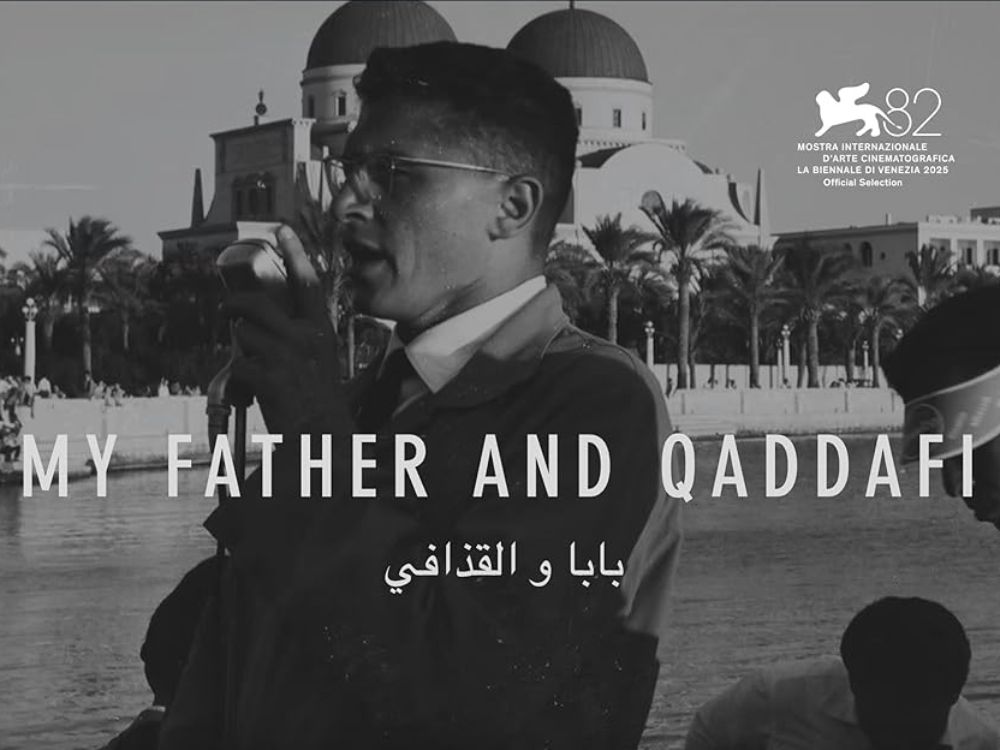
"My Father & Qaddafi," which premiered out of competition at the Venice International Film Festival in 2025, tells the story of Mansur Rashid Kikhia, Libya's former foreign minister, later ambassador to the United Nations, and ultimately one of the most prominent peaceful opponents of Muammar Qaddafi. In December 1993, while attending a human rights meeting in Cairo, he was abducted and disappeared. The film is directed by his daughter, Libyan-American filmmaker Jihan Kikhia (credited as Jihan K). At 88 minutes, it is both a daughter's effort to reconstruct the life of a father she barely remembers and a cinematic attempt to preserve a political history that Libya itself has never properly recorded.
Mansur Rashid Kikhia's career and disappearance cannot be understood without the longer arc of Libyan history. The country passed from Italian colonization (1911–1943) to British and French administration after World War II, then into a constitutional monarchy under King Idris from 1951 until 1969. On September 1, 1969, a group of young army officers led by Muammar Qaddafi deposed the monarchy in a coup. Qaddafi would rule for 42 years, presenting himself as a revolutionary while centralizing power.
Oil wealth funded development projects and ideological campaigns, but dissent was crushed with imprisonment, public executions, forced exile, and assassination. By the late 1970s, Qaddafi had created "Revolutionary Committees," a paramilitary and political network that enforced loyalty to his rule, promoted "The Green Book"—his political manifesto published between 1975 and 1979—as required ideology in schools and workplaces, and monitored dissent across Libyan society.
Dissidents abroad were also targeted by Libyan intelligence services, sometimes with the cooperation of foreign governments that sought to maintain relations with Tripoli.
It was within this environment that Mansur Kikhia rose to prominence. Coming from a distinguished Libyan family, he joined the new government after the 1969 coup, serving as Minister of Foreign Affairs between 1972 and 1973 and later as Libya's Ambassador to the United Nations.
By the late 1970s, disillusioned with Qaddafi's authoritarianism and the regime's systematic use of violence, he resigned his post in protest. In 1980, he went into exile, eventually settling in the United States, where he gained permanent residency.
Unlike armed factions that attempted to overthrow Qaddafi by force, Kikhia insisted on peaceful opposition and human rights advocacy. He became a leading figure in international forums where he urged attention to Libya's political prisoners and disappearances. His stance effectively made him a marked man.
On December 10, 1993, while in Cairo to attend a meeting of the Arab Organization for Human Rights, Kikhia was abducted outside his hotel by men witnesses described as traveling in a limousine with diplomatic plates. A CIA investigation later concluded that Egyptian agents carried out the abduction and handed him to Libyan intelligence.
For nearly two decades, his family had no confirmation of his fate. It was only after the fall of Qaddafi in 2011 that his body was discovered in a freezer inside a villa belonging to Libyan military intelligence in Tripoli. The discovery followed the arrest of intelligence chief Abdullah al-Senussi, who disclosed the location after his capture.
That crime, and the silence that followed it, defines the family story at the center of "My Father & Qaddafi." Jihan was six years old at the time of her father's abduction. Her mother, Syrian-American artist Baha Al Omary, began what would become a 19-year search, a pursuit that took her to foreign capitals and even into direct confrontation with Qaddafi himself in the Libyan desert. Her testimony is the emotional spine of the film. She describes both the exhaustion of navigating endless negotiations with officials who offered nothing and the determination to keep the search alive.
Decades later, Jihan picks up this thread not to find her father—by then the facts of his death were known—but to reconstruct his life, his political choices, and the meaning of his absence. The film becomes both her investigation and her way of asserting a Libyan identity that dictatorship and exile threatened to erase.
Formally, "My Father & Qaddafi" is constructed from a layered archive. It uses family photographs and home videos, diplomatic records and televised appearances, international news reports, and contemporary interviews with relatives, colleagues, and political figures who knew Kikhia. Editors Alessandro Dordoni, Nicole Halova, and Chloë Lambourne weave these sources into a chronology that alternates between past and present.
The film interrogates its archival material rather than presenting it passively, continually asking what can be known and what must remain incomplete.
Cinematographers Micah Walker and Mike McLaughlin shoot contemporary interviews and landscapes with clarity, which is then juxtaposed with historical images whose grain and static emphasize temporal distance. The sound design maintains a low profile, with a score contributed by multiple composers that shifts between sparse Middle Eastern motifs and subdued strings, designed to underline rather than overwhelm.
Because Jihan's own memories of her father are limited, the narrative relies heavily on the voices of others. Her mother's testimony, her siblings' recollections, and colleagues' eyewitness accounts fill the gaps left by her childhood absence. Rather than inventing intimacy, the film makes the absence visible. The lack of direct father–daughter memories is not a weakness but part of the point: disappearance leaves behind fragments, and the fragments are what families must live with.
At the same time, the film functions as a political history of Libya under dictatorship. It shows how opposition voices were erased not just physically but from the historical record. The regime promoted 1969 as the authentic beginning of Libya's history, suppressing knowledge of the monarchy and rewriting national identity with propaganda. Generations grew up under this official amnesia. By refusing to let her father's story be buried, Jihan K is also refusing the state's erasure of memory.
The film is a US–Libyan co-production with Swedish participation, supported by the Doha Film Institute, the Arab Fund for Arts and Culture, the International Documentary Association, CineGouna, International Media Support, Hot Docs–Blue Ice, and the Swedish Film Institute. It developed across regional and international platforms, including Close Up, Qumra, Durban Filmmart, and First Cut.
Cairo-based MAD Solutions has rights for Arab territories, with MAD World handling international sales.
The timing of the film's release is notable. Since Qaddafi's fall in 2011, Libya has remained divided between rival governments, militia rule, and contested authority. No truth and reconciliation process has taken place, and archives remain locked, destroyed, or politically manipulated.
In this vacuum, films like "My Father & Qaddafi" function as repositories of memory. They assemble testimony and evidence in forms that may outlast political instability and make records available to future generations.
The film does not claim to be an official inquiry, but it performs some of the same functions: preserving evidence, placing violence on record, and ensuring that those who disappeared are not erased again by silence.
For the global industry, the film is a reminder of the conditions under which Libyan cinema has had to operate. Qaddafi dismantled cinema as a public institution, folding it into the General Council for Cinema between 1973 and 2010, which produced state-aligned documentaries and a small number of short films. Independent production was nearly impossible. After 2011, hopes for renewal were tempered by civil conflict and social resistance to cinema.
Under those conditions, the New York African Film Festival New York premiere of "My Father & Qaddafi" represents the ongoing, albeit slow, reintroduction of Libyan voices to international cinema after decades of suppression. It also makes clear that a work like this is only possible thanks to diaspora initiative and international co-production, since no domestic infrastructure yet exists to support projects of this scale.